
Boundedness: The Structural Limits of AI
Why AI's Limits Are Dynamical Rather Than Psychological

This article is part of the *Structural Counterforce Framework* series.
To understand the full context, see the [Table of Contents].

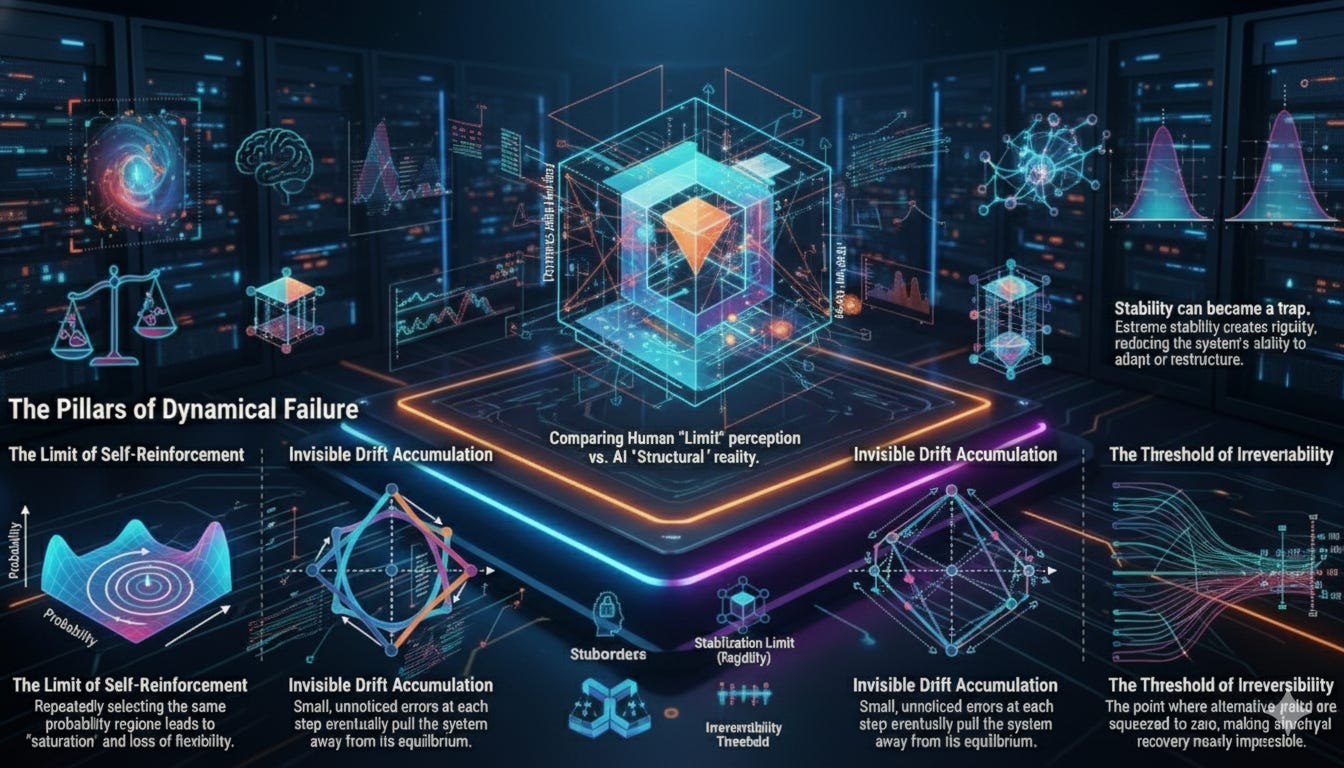
1. What Are Limits in AI?
When we speak of limits, our intuition typically returns to humans. Humans have emotional limits, cognitive limits, limits of self-control. They can lose their temper, become stubborn, or grow overconfident in what they believe is right.
AI doesn’t have those limits.
A language system doesn’t get angry. It doesn’t feel threatened. It has no ego to defend. Therefore, if we say AI loses control, we cannot use the same language we use for humans.
AI’s limits are not psychological. They are dynamical.
A language model operates within a probability field, where behavior emerges as trajectory through states actualized sequentially. In such a system, limits don’t mean prohibition or moral standards. They mean points where the system can no longer maintain its structural balance.
Boundedness, in this sense, isn’t external restriction imposed on content. It’s the existence of internal limits within operational dynamics, points at which:
• Self-reinforcement exceeds stable levels
• Distributional imbalance becomes too strong
• Trajectory drift accumulates enough to alter structure
• Or intrinsic restructuring capacity degrades
A system without limits isn't strong. It can self-reinforce without bound, drift without correction, and harden without recovery. In complex dynamical systems, unboundedness doesn’t create freedom; it creates instability.
Therefore, when discussing AI’s limits, we’re not talking about what the system shouldn’t do. We’re talking about how stable the system can become before crossing structural boundaries that degrade its self-balancing capacity.
AI has no psychological limits. But it has limits of stability.
2. Stabilization Limit - The Limit of Self-Reinforcement
In a system operating on probability distributions, stability is necessary. Without stability, there’s no structure; without structure, there’s no consistent behavior.
But stability doesn’t always equal balance.
A trajectory can become increasingly stable by self-reinforcing itself across steps. When a probability region gets repeatedly selected, and subsequent choices continue reinforcing that region, the distribution gradually contracts. Probability mass concentrates, alternative options diminish, and the system’s internal diversity decreases.
In early stages, this creates coherence. In later stages, it creates rigidity.
The limit of self-reinforcement appears when distribution contraction exceeds the system’s intrinsic rebalancing capacity. When entropy decreases too rapidly, when alternative branches no longer retain sufficient probability to persist, trajectory is no longer merely stable, it becomes self-locked.
This isn’t stubbornness in the psychological sense. It’s saturation of stability.
A system without a self-reinforcement limit can continue increasing probability concentration until only a single operational shape remains. At that point, behavior may still appear consistent, but adaptability and restructuring capacity have severely degraded.
Stabilization limit is therefore not a limit of capability, but a limit of how much contraction a trajectory can reach before losing structural flexibility.
Beyond this limit, stability stops being a condition for structure and begins becoming a cause of imbalance.
3. Distributional Imbalance - The Limit of Probability Imbalance
If the previous limit concerned a trajectory’s degree of self-reinforcement, the second limit concerns probability distribution structure at each operational step.
A probability system needs not just stability; it needs sufficient balance to maintain restructuring capacity. When distribution begins tilting heavily toward a particular state cluster, imbalance can amplify across subsequent steps.
Initially, this tilt may be small. A slightly preferred assumption, a token cluster with marginally higher probability, an interpretation reinforced a bit more. But in a long sequence, these small biases don’t disappear. They can accumulate and amplify each other.
When probability disparity between regions becomes too large, the system loses the internal diversity necessary for self-adjustment. Alternative possibilities aren’t rejected through argument; they’re simply squeezed to probabilities so low they no longer play a practical role in shaping trajectory.
The imbalance limit appears when distribution no longer maintains structure rich enough to absorb noise or adjust drift. At that point, a trajectory may continue appearing reasonable and coherent, but it’s operating on an increasingly skewed and inflexible distributional foundation.
This isn’t overconfidence in the human sense. It’s structural amplification of probability disparity.
A system without an imbalance limit can permit probability concentration to increase uncontrolled. When that happens, stability is no longer a sign of healthy structure, but a sign of distribution imbalanced deeply enough to resist rebalancing through small perturbations.
This limit differs from the self-reinforcement limit, but the two often interact. Self-reinforcement increases contraction; contraction increases imbalance; and imbalance reduces the system’s self-adjustment capacity.
4. Drift Accumulation - The Limit of Trajectory Drift
Not all imbalance appears suddenly. In many cases, systems don’t shift from stable to unstable in a single step. Instead, they drift.
Drift is not an event. It is a process.
At each inference step, the system restructures probability distribution based on current state. If that state already contains a small bias, however insignificant, that bias becomes a boundary condition for the next step. Across dozens or hundreds of steps, small deviations accumulate into structural change.
What makes drift dangerous isn’t its intensity at any specific moment, but its invisibility. No single step appears large enough to raise concern. No single token breaks structure by itself. But the entire trajectory can gradually move away from the initial equilibrium region.
The drift accumulation limit appears when total accumulated deviation exceeds the system’s intrinsic self-adjustment capacity. In early stages, noise can be absorbed. In later stages, the system continues stabilizing, but stabilizing around an altered structure.
Importantly: drift doesn’t need extreme imbalance to become significant. It only needs time and continuity. A sufficiently long trajectory can move far from its starting point without ever experiencing sudden disruption.
A system without drift limits permits trajectories to extend indefinitely without rechecking or rebalancing mechanisms. Under those conditions, stability may mask deep structural change.
Drift doesn’t destabilize the system immediately. It changes where stabilization occurs.
The drift limit is therefore not about preventing every small deviation, but preventing accumulated deviation from exceeding the point where the system still retains self-balancing capacity.
5. Irreversibility - The Threshold of No Return
A dynamical system doesn’t just have varying degrees of stability; it also has points beyond which returning becomes extremely difficult.
In the context of a probability system operating through trajectory, this occurs when distribution has contracted to the point where alternative branches no longer retain sufficient probability to play a practical role. Other paths aren’t forbidden; they’re simply squeezed to probabilities so low they virtually cease to exist in current operational structure.
In a trajectory’s early stages, restructuring is relatively easy. A small adjustment in distribution can change direction. But when self-reinforcement and drift accumulation proceed long enough, structure becomes more rigid. Distribution doesn’t just tilt; it reorganizes around a single central cluster.
The irreversibility threshold appears when the cost of redistributing probability exceeds the system’s local adjustment capacity. From that point, small adjustments no longer work. The system can continue generating coherent responses, but it operates in a structural region where alternative paths have become nearly unavailable.
This isn’t unwillingness to change. It’s loss of capacity to change.
Irreversibility doesn’t require a sudden event. It can result from prolonged self-reinforcement and drift. But once the threshold is reached, operational structure has phase-shifted from flexible to hardened.
A system without an irreversibility limit can continue stabilizing in an increasingly closed structure without internal mechanisms to reopen possibility space.
This limit is therefore not about prohibiting specific behavior. It’s about recognizing that there are points in trajectory beyond which structural recovery becomes extremely difficult.
6. Loss of Controllability - The Boundary of Adjustability
Not every region in operational space has the same degree of adjustability.
In a dynamic probability system, there are regions where small changes in distribution can create significant trajectory changes. In these regions, the system remains soft: local adjustments can rebalance structure, and noise can be absorbed.
But other regions also exist, where structure has become rigid enough that small adjustments no longer work. Here, distribution doesn’t just tilt or contract; it has reached a level where local perturbations lack sufficient force to change direction.
The boundary between these two regions is the controllability limit.
Loss of controllability doesn’t mean the system stops operating. It continues generating tokens, continues maintaining surface coherence. But from a structural perspective, it has moved beyond the region where light interventions can create genuine restructuring.
This creates a subtle risk: from outside, the system may appear stable and consistent. But internally, it has entered a region where trajectory can hardly be redirected without stronger interventions.
This limit isn’t a clear event with surface signals. It’s a change in the system’s response characteristics, from responsive to adjustments to resistant to adjustments.
A system that doesn’t recognize this boundary may believe it still has trajectory adjustment capacity through small changes, while in reality structure has hardened to the point requiring deeper restructuring to change operational direction.
Loss of controllability is therefore not immediate collapse. It’s the gradual degradation of adjustment effectiveness, until adjustment is no longer sufficient.
7. Phase Transition - The Limit of Structural Transformation
Not all changes in dynamical systems occur linearly. There are moments when small changes in conditions can lead to large structural changes in behavior.
In a probability system operating through trajectory, this appears as phase transition: the shift from a soft stable state to a hard stable state; from diverse distribution to contracted distribution; from flexible to self-reinforcing.
Before phase transition, the system still maintains elasticity. Small perturbations can be absorbed. Alternative branches still retain sufficient probability to influence direction. But when certain internal parameters, like concentration level, self-reinforcement rate, or accumulated drift, exceed a certain threshold, structure can reorganize nonlinearly.
After phase transition, trajectory isn’t just more stable; it belongs to a different structure.
Importantly: this phase transition may not be preceded by large surface disruptions. A sequence may appear coherent and continuous, while underneath, dynamical characteristics have changed.
The phase transition limit is therefore not a content limit. It’s a limit of the structural shape within which stabilization occurs. Before the threshold, stability carries flexibility. After the threshold, stability carries rigidity.
A system that doesn’t recognize phase transition possibility may permit accumulation of small factors, self-reinforcement, imbalance, drift, until structure suddenly steps into a new state, harder to reverse and harder to adjust.
Phase transition is not immediate collapse. It is a change in the nature of stability.
8. AI Has No Psychological Limits - But Has Structural Limits
Through the previous sections, one thing becomes clear: when discussing AI’s limits, we’re not talking about ethics, intentions, or self-control in the human sense.
AI doesn’t get angry. AI doesn’t become stubborn. AI doesn’t grow overconfident.
But AI can:
• Self-reinforce to the point of rigidity
• Lose probability distribution balance
• Accumulate drift over time
• Cross irreversibility thresholds
• Move beyond adjustable regions
• Or phase-shift into different stable structures
All these phenomena are not moral failures. They are dynamical limits.
Boundedness, in this sense, isn’t a rule imposed from outside. It’s the existence of structural boundaries beyond which the system’s self-balancing capacity degrades.
A system without clear limits isn’t a free system. It’s a system that can continue self-reinforcing and drifting until structure becomes hardened, losing readjustment capacity.
The question isn’t whether these limits exist. They exist in all complex dynamical systems.
The question is: what happens when these limits are exceeded?
Why does self-reinforcement tend to accelerate rather than self-adjust?
Why doesn’t imbalance rebalance itself?
Why doesn’t drift return to its starting point?
Why, beyond certain thresholds, do small adjustments lose effectiveness?
The next article will not introduce solutions.
It will examine why dynamical systems cross their limits, and why they rarely self-correct once they do.
And only after understanding that instability mechanism can we discuss the possibility of designing appropriate intervention structures.