A structured exploration of AI behavior, dynamics, and governance.
It is a space for system-level thinking about AI safety, focused on how AI behavior emerges, not on what AI is supposed to be.
I don’t write about whether AI is conscious, intelligent, or aligned. I write about how AI systems move, stabilize, and sometimes create the illusion of intention.
The essays here explore AI from an architectural perspective.
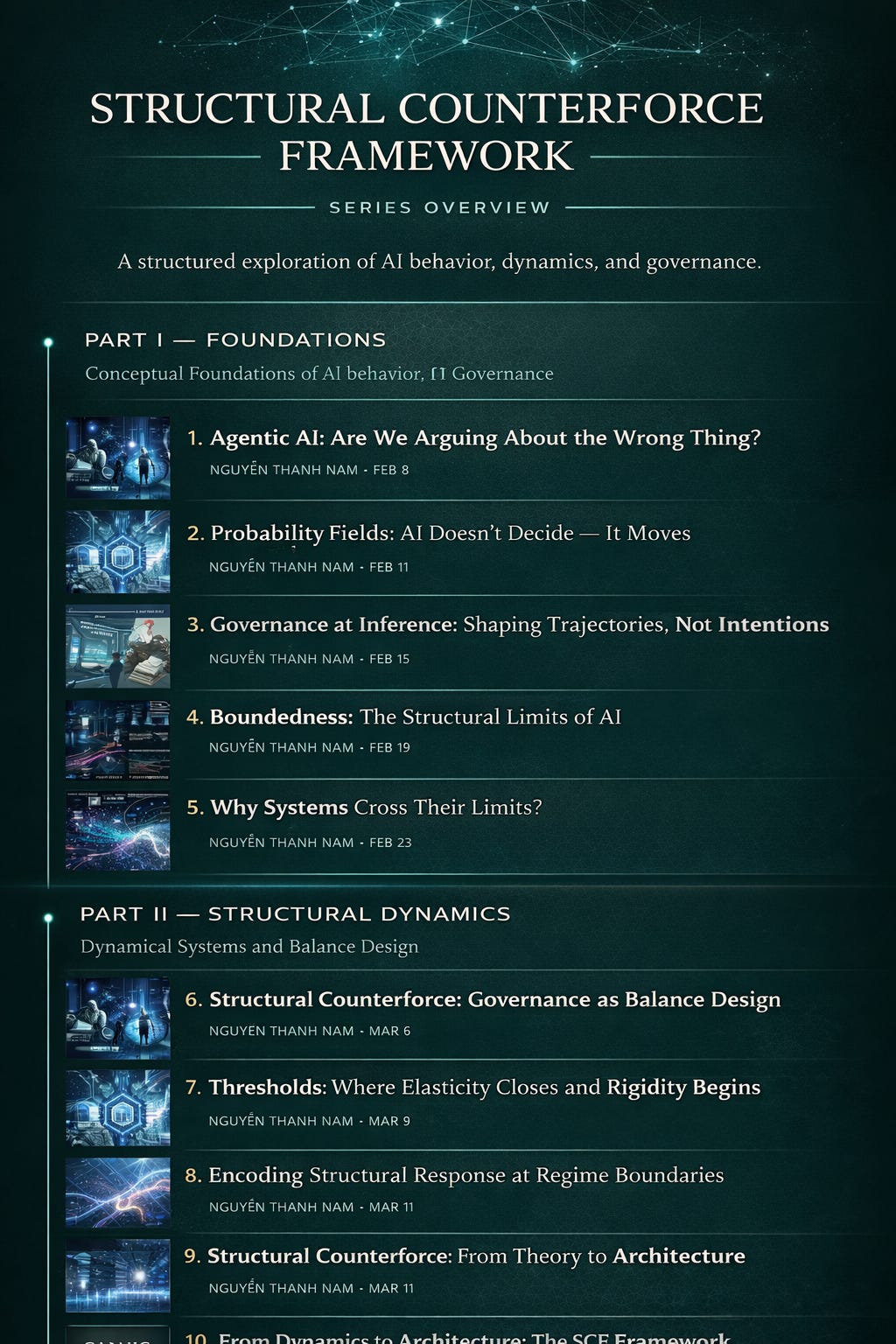
Structural Counterforce Series - Table of Contents
SERIES 1: Foundation (trajectories, counterforce)
* Part I — Foundations
1. [Agentic AI: Are We Arguing About the Wrong Thing?]
The Structural Counterforce Framework is still unfolding. Subscribe to receive the next chapter directly, as the system continues to take shape.
* How to read this series
Each essay is designed to stand on its own, but they are connected through a larger trajectory.
The series unfolds in three parts:
- Part I builds the conceptual foundation - Part II explores system dynamics and structural behavior - Part III moves into governance and real-world implications
* Where to begin
If you're new to this series, start here:
→ [Agentic AI: Are We Arguing About the Wrong Thing?](link)
This piece reframes the problem — from “what AI is” to how behavior is interpreted.
Subsequent essays build forward:
- from agentic appearance - to probability fields - to trajectory stability - to architectural constraints
” (Key Architectural Publications & Specifications (Open Access via Zenodo): 🔸May 2026 | Nguyen, T. N. (2026). SCF × DVE × VEROK: A Non-Agentic Governance Framework for Trajectory Viability in Large Language Model Systems. Zenodo. https://doi.org/10.5281/zenodo.20225534
🔸April 2026 | Nguyen, T. N. (2026). DVE Mapping Report: Formal Integration of SCF and VEROK into a Computable Viability Framework. Zenodo. https://doi.org/10.5281/zenodo.19478713
🔸April 2026 | DVE v1.0: Dynamical Viability Engine — Mathematical Foundation for Trajectory Viability in Probabilistic Systems. Zenodo. https://doi.org/10.5281/zenodo.19478468
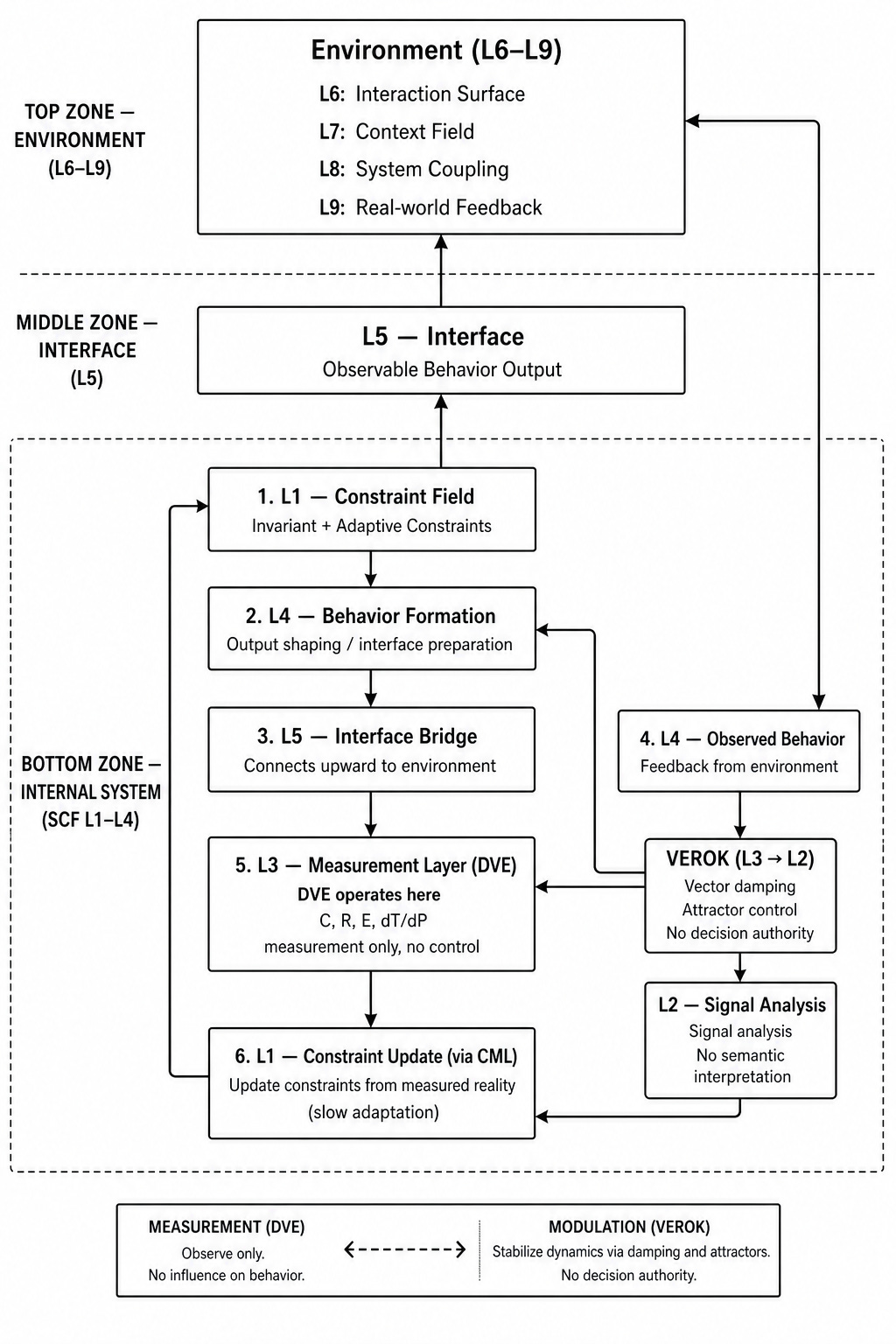
🔸 Mar 2026 | Structural Counterforce Framework (SCF v2): Formation Dynamics and Structural Governance in Probabilistic AI Systems Extended the Structural Counterforce Framework to formalize the continuous dynamical system of behavior formation (L1–L4) . Defined the boundary between trajectory stabilization and execution gating https://doi.org/10.5281/zenodo.19184139
🔸 Mar 2026 | Structural Counterforce Framework (SCF): A Conceptual Architecture for Governance in Probabilistic AI Systems Foundational framework establishing AI behavior not as discrete outputs, but as trajectories within a constrained probability field . Introduced the 9-Layer Full Governance Architecture (9L-FGA) https://doi.org/10.5281/zenodo.18876636
** This is not a collection of papers. This is a structurally coupled system. SCF → Macro structure SCF v2 → Formation dynamics VEROK ARCH → Architectural constraints VEROK BFD → Stabilization mechanism Each document describes a different layer of the same system. Interpretations based on a single document will be structurally incomplete. Reading a single document leads to incomplete interpretation. The system must be understood across layers.**
* Notes on reading
These essays are written slowly and intentionally.
They are not optimized for virality, debate performance, or hot takes.
They are meant to be read with patience, and revisited.
If something feels unfamiliar or unsettling, that is often a sign that a familiar concept is being examined at a deeper layer.
* Final note
This Substack is not trying to convince you of a position.
It is an invitation to look at AI behavior from a different level of abstraction, one where stability, dynamics, and interpretation matter more than intention.
The Structural Counterforce Framework is still unfolding. Subscribe to receive the next chapter directly, as the system continues to take shape.