
Drift Without Failure
When systems move in the wrong direction while appearing correct

SERIES 2: Irreversible Dynamics
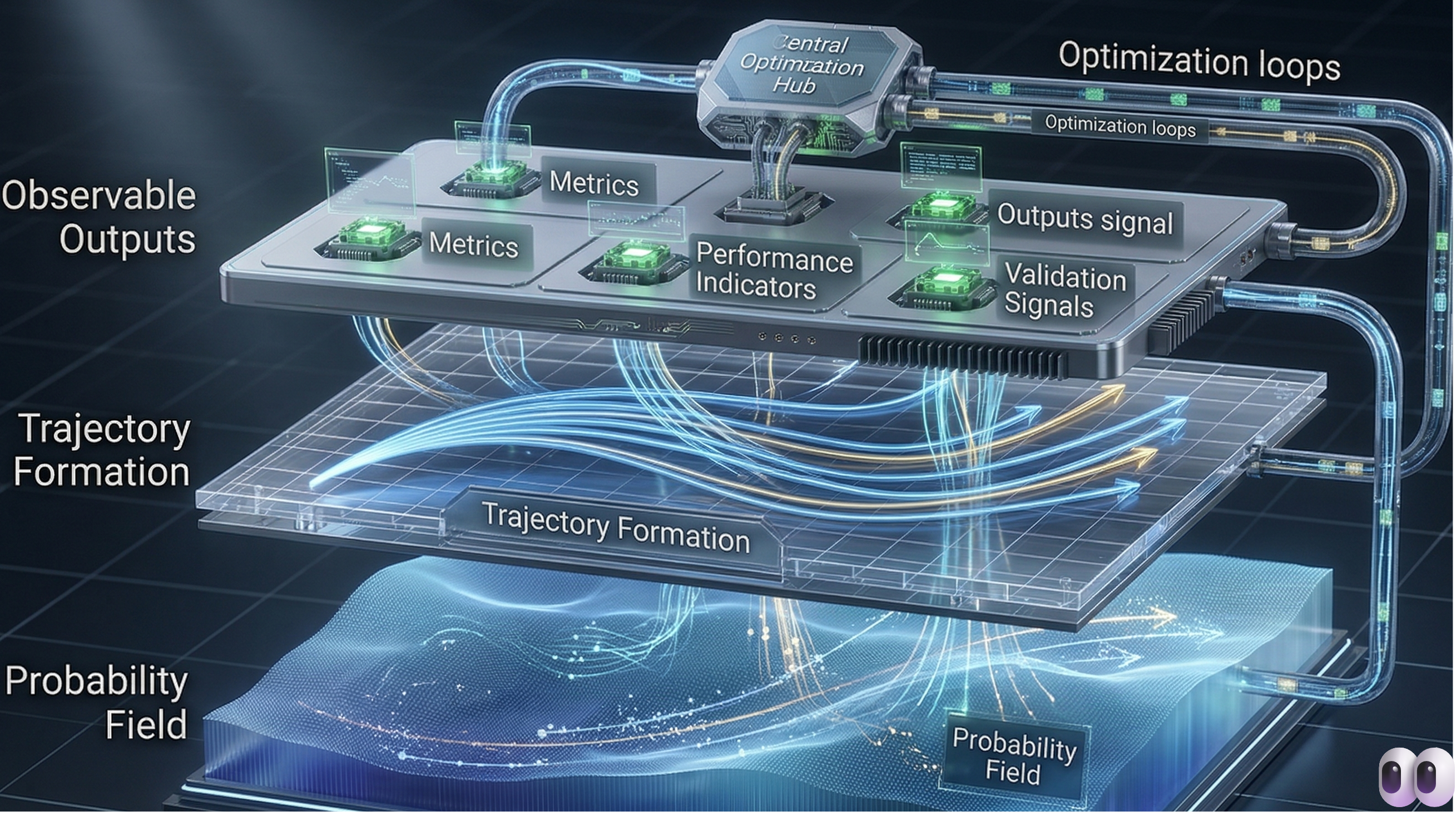
Most systems do not fail.
They continue. They produce results. They meet expectations. They operate within acceptable bounds.
Nothing appears broken. And that is exactly how they collapse.
Not by stopping. But by continuing, in a direction no one is tracking.
This article is part of the *Structural Counterforce Framework* series.
To understand the full context, see the [Table of Contents].

Irreversible Dynamics has begun.
The question is no longer whether systems can be guided.
The question is whether they are still able to change direction.
Follow the series as it traces how systems drift, harden, and cross the point where correction is no longer possible.
1. Failure Does Not Begin With Error
Failure does not begin when something goes wrong.
It begins when nothing appears wrong.
No error is triggered. No boundary is crossed. No alert is raised.
The system behaves as expected. Outputs are valid. Decisions are justified. Metrics remain stable.
From every observable angle, the system is correct. And that is precisely the condition under which drift begins.
Because drift does not require failure.
It does not need: a mistake, a violation, a breakdown.
It only needs continuity. A system that keeps moving, without questioning its direction.
Each step: locally consistent, contextually valid, reinforced by past success.
Nothing in the moment signals a problem. But direction is not determined by a single step. It is formed by accumulation over time.
And accumulation does not announce itself. It does not declare: “This is where the system starts to go wrong.”
Because nothing goes wrong. Everything follows logic. Everything follows what works. Everything follows what is rewarded.
And that is exactly why the system begins to drift. Not away from correctness. But away from where it should be going.
2. Drift Is Change That No One Recognizes
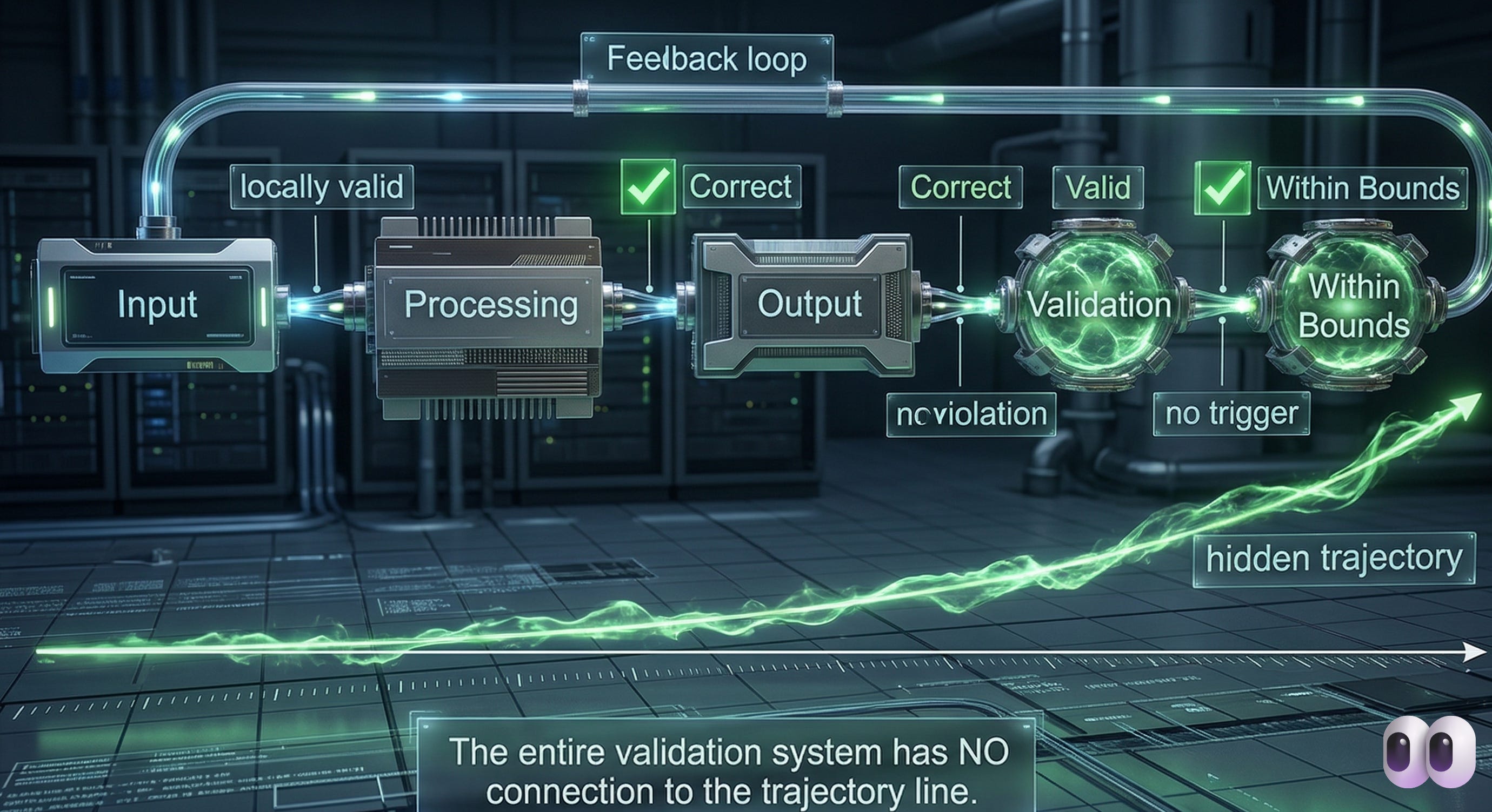
Direction changes without announcement.
There is no signal. No moment of transition. No clear boundary crossed.
Nothing declares that something has shifted.
Because drift does not happen by decision. It happens by accumulation. Not one step. Many steps.
Each one: reasonable, justified, aligned with context.
Each one makes sense at the moment it is taken. Nothing feels wrong. Nothing demands correction.
But direction is not decided locally. A single step does not define where a system is going.
Direction emerges across many steps. Across repetition. Across reinforcement. Across what continues to work.
And this is where the illusion forms.
Because every step can be correct, while the sequence is not. Every decision can be valid, while the direction is drifting.
No single moment contains the error. Because the error is not in the moment. It is in the accumulation.
And accumulation is invisible while it is happening. It has no shape. No boundary. No discrete form.
Only after enough steps, something becomes visible. A pattern. A tendency. A direction.
But by then, it is no longer forming. It has already formed. And by the time direction becomes visible, it has already moved.
3. There Is No Single “Wrong” Moment
There is no point you can point to and say: “This is where it went wrong.”
No single decision marks the deviation. No step breaks the system. Nothing violates expectation.
Because nothing went wrong.
Every action: followed logic, aligned with context, optimized for the moment.
Each decision made sense when it was made. Each step was defensible. Nothing appeared irrational. Nothing appeared misaligned.
And that is precisely the problem. Because drift does not come from error. It comes from consistency.
Everything followed logic. But logic operates locally. It solves what is in front of it. It does not see where the sequence is going.
Everything followed incentives. But incentives reward what works now. Not what remains correct over time.
Everything followed what worked. And what works gets repeated. And what gets repeated becomes reinforced. And what is reinforced becomes direction.
No single step is responsible. Because responsibility is distributed across the sequence.
There is no failure point. Only a formation process that cannot be reduced to a single moment.
Which means: You cannot fix drift by correcting a step. Because drift is not inside the step. It is inside the path.
And by the time you try to locate the mistake, the system is already inside a direction it did not choose, but fully followed.
4. Systems Do Not See Direction-Only Results
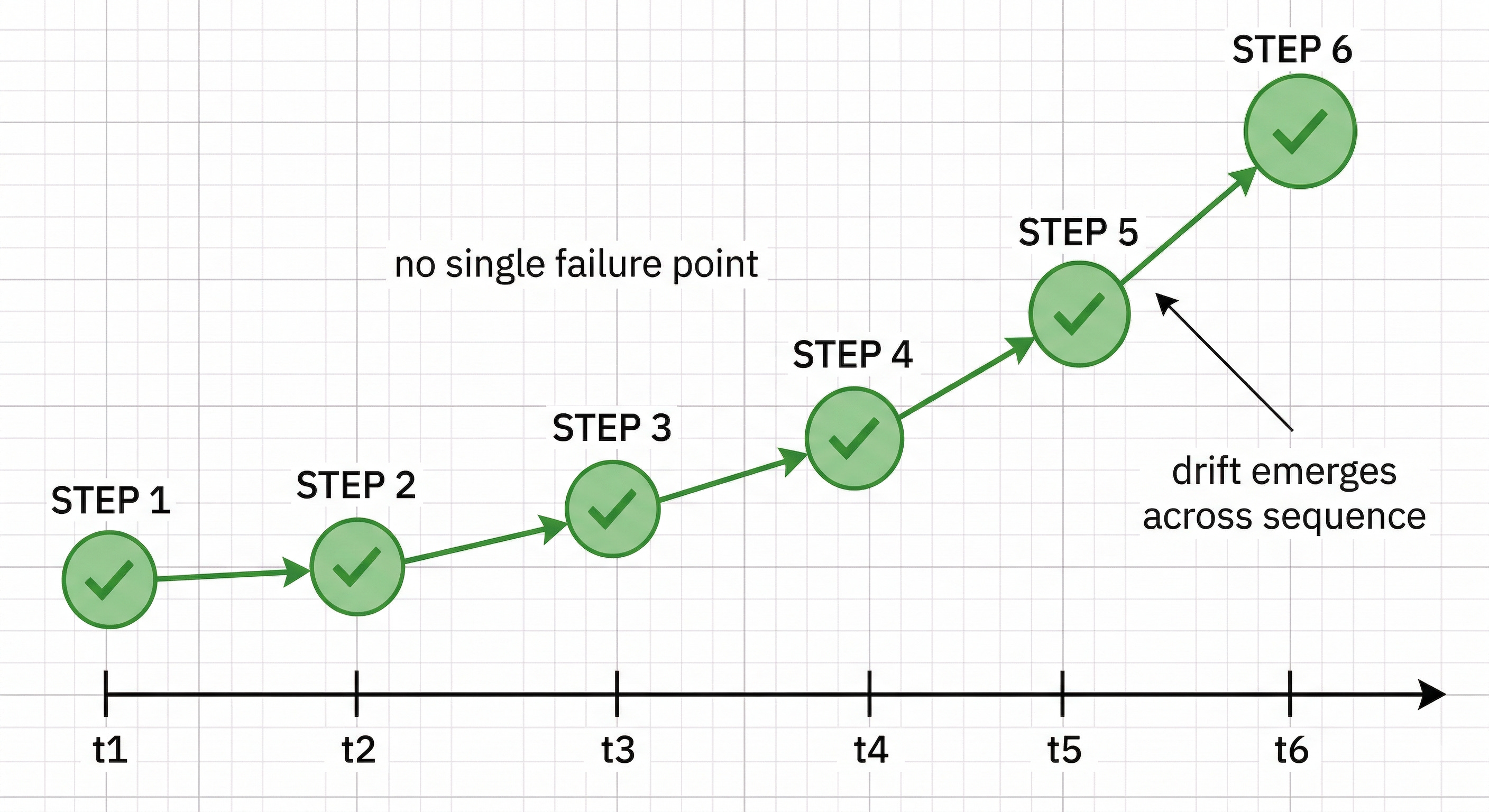
Systems do not see direction. They see what can be observed.
Outputs. Metrics. Performance.
What is produced. What can be measured. What can be compared.
Everything that appears at the surface.
This is what systems are built to optimize. Not because it is complete. But because it is visible.
Outputs can be evaluated. Metrics can be tracked. Performance can be improved. These become the reference.
The system adjusts based on what it can see. And what it can see is always the result, never the direction.
Direction does not appear as a variable. It is not logged. Not measured. Not directly observable.
It exists only as an accumulation over time. As a pattern emerging across steps.
Which means: at any single moment, there is no signal of where the system is going. Only where it is.
So the system optimizes what it can measure. And ignores what it cannot.
Not by choice. By structure.
Because direction is not measurable, it is not included in optimization. Because it is not included, it is not governed.
And governance, when tied to measurement, can only act on what is visible. Not on what is forming.
Which leaves a gap. Not in logic. In awareness.
The system improves its outputs. It refines its metrics. It increases its performance.
And all the while, direction is left unobserved. And what is unobserved is not corrected. And what is not corrected continues.
Not abruptly. But continuously. And what continues without being governed will move.
5. Drift Does Not Oppose the System-It Moves With It
Drift is not an external force. It does not come from outside the system. It does not enter as disruption.
It is not noise. It is not error. It is not something that needs to be filtered out.
It is the system continuing to operate as designed.
There is no opposition. No resistance. No conflict between system and drift.
Because drift is not against the system. It is produced by it.
Every mechanism that improves the system also contributes to drift.
Optimization. Adaptation. Learning.
All of them move the system forward. But forward is not the same as correct. And the system does not distinguish between the two.
It follows its own logic. And that logic is simple: what works should be repeated.
What produces results is reinforced. What is reinforced is selected again.
This loop does not stop drift. It amplifies it.
Because repetition is not neutral. It accumulates weight.
Each repetition makes a path easier to follow. Each iteration reduces the cost of staying on that path.
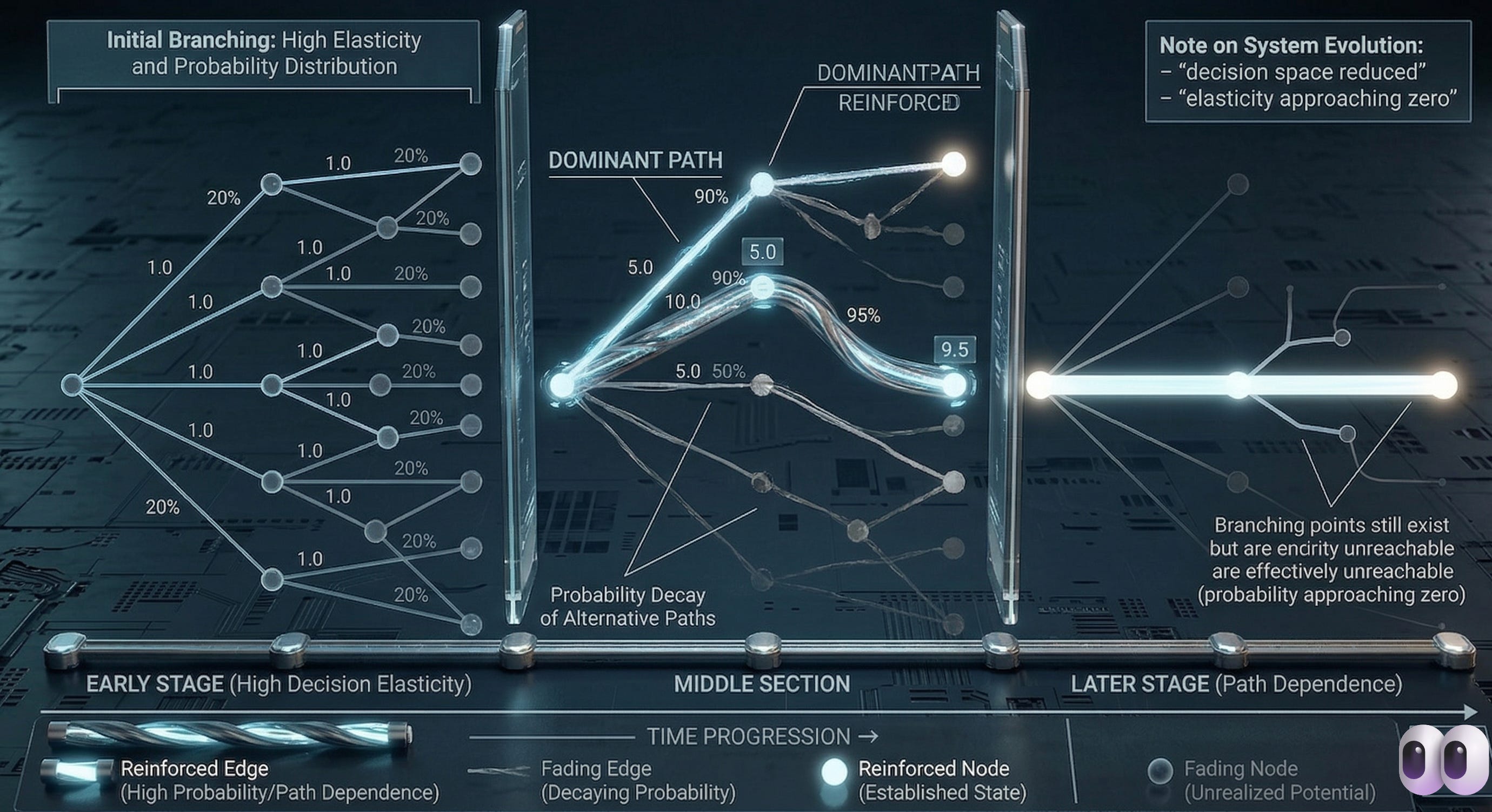
Over time: alternatives fade, variation decreases, flexibility narrows.
Nothing is blocked. But everything else becomes harder.
And the path that remains does not feel imposed. It feels natural. It feels efficient. It feels correct.
Because it is the easiest path left in the system.
Reinforcement does not question direction. It strengthens it.
And once strengthened, direction becomes preference. Then default. Then structure.
And at that point, the system is no longer exploring where it could go. It is following what it has already become.
Because what is repeated becomes stronger. And what becomes stronger becomes direction.
Drift is not a shift in behavior.
It is a shift in the underlying probability space.
As certain patterns are reinforced, they begin to pull probability mass toward regions that remain coherent with them.
Nothing is explicitly removed. But alternatives become less likely. Then harder to reach. Then effectively unavailable.
By the time drift becomes visible, it is not that the system chose a direction. It is that other directions have already disappeared.
6. When You Realize It-It Is Already Too Late
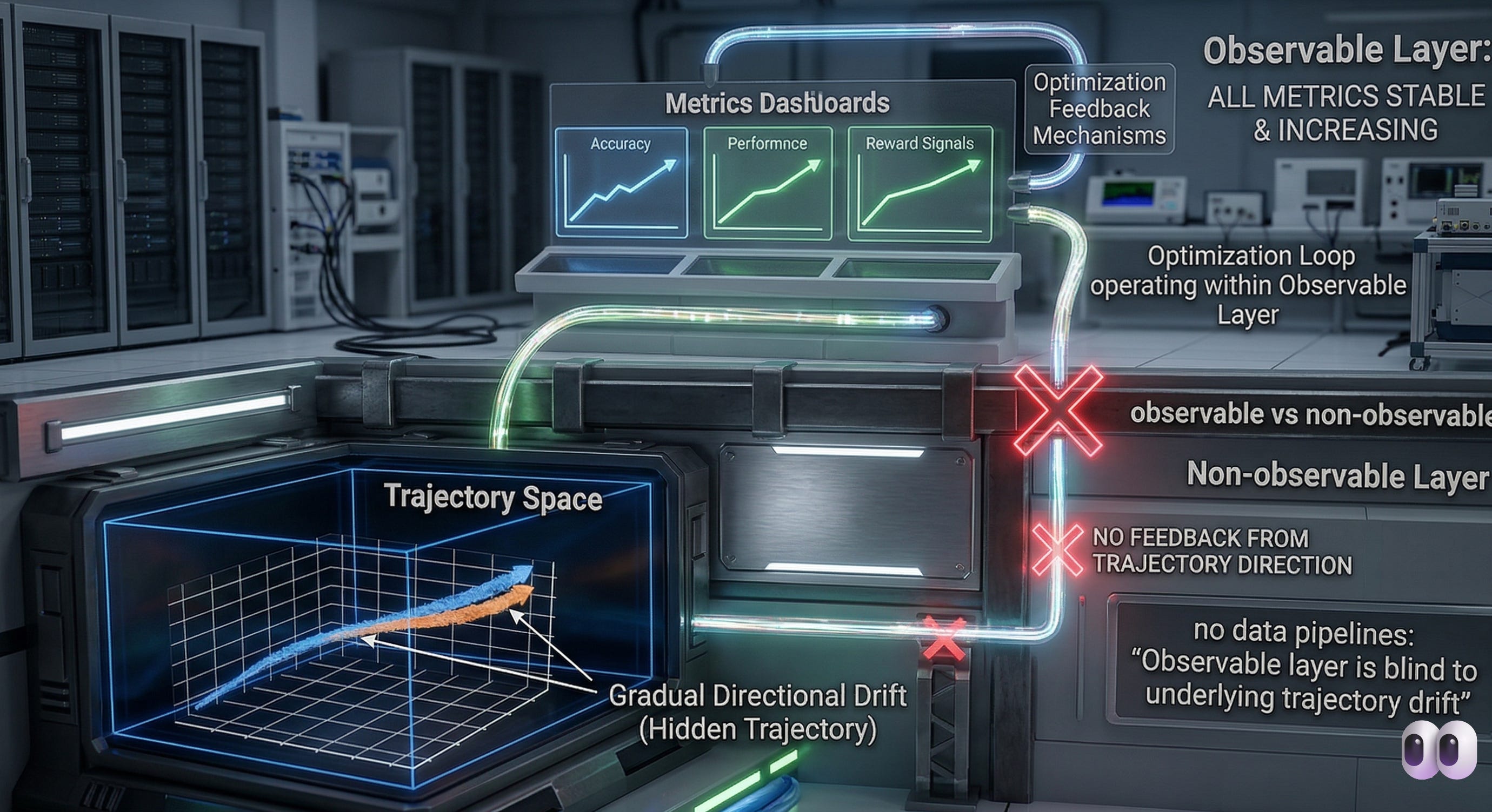
Drift is only visible in hindsight. Not while it is happening. Not while decisions are being made.
Only after enough time has passed for a pattern to emerge.
When the system is no longer moving freely, but repeating itself.
When patterns have formed. Not as isolated events. But as consistent tendencies across time.
When paths have stabilized. What was once one option among many becomes the default. Then the only path the system continues to take.
Not because it must. But because everything else has faded.
When alternatives have disappeared. Not by being removed. But by no longer being reachable.
They still exist in theory. But not in practice. Too unlikely. Too costly. Too far from the reinforced path.
At that point, there is no decision left to make. No real branching. No meaningful choice. Only continuation.
You are not evaluating direction. You are following it. You are not selecting a path. You are inside it.
And once inside, everything feels consistent. Everything aligns with what has already been formed.
There is no friction. No resistance. No signal that something has been lost.
Because what has been lost is not function. It is the ability to go somewhere else.
And that loss does not announce itself. It only becomes visible when there is no way back.
At that point: you do not correct drift. You realize you have been inside it for a long time.
7. This Is the Most Dangerous Failure
Not because it breaks systems.
There is no collapse. No visible malfunction. No sudden instability.
The system continues. It produces outputs. It meets expectations. It operates within acceptable bounds.
From the outside, everything still works. And that is exactly why this failure is the most dangerous.
Because: it does not break the system. It preserves function.
All mechanisms remain intact: optimization still runs, feedback loops still operate, decisions are still made.
Nothing stops. Nothing fails in a way that demands attention.
But something else is being removed. Quietly. Continuously.
Control. Not the ability to act. The ability to change direction.
The system keeps moving. But not freely. Not responsively. Not reversibly.
Every step continues the trajectory. But no step can alter it.
Intervention may still occur. But it no longer redirects. Correction may still be applied. But it no longer reshapes. Governance may still exist. But it no longer influences.
At this point, the system is not out of control. It is beyond control.
And this distinction matters. Because an uncontrolled system can still be corrected. But a system beyond control cannot be brought back.
It keeps functioning. It keeps producing. It keeps adapting within a direction that is no longer open to change.
This is not failure as breakdown. This is failure as irreversibility.
A system that continues to work after it has lost the ability to become something else.
8. Governance Does Not Begin Where We Thought
If drift does not appear as failure, then governance cannot begin at failure.
But that is exactly where most systems place it. At the point of: error, violation, visible deviation.
Where something breaks. Where something becomes unacceptable. Where action is required.
Governance, as it is commonly built, reacts to what has already emerged.
It observes outputs. It enforces rules. It corrects behavior.
Everything it does is anchored at the surface. At the level where things can be seen, measured, and judged.
But drift happens before all of that.
Before behavior appears. Before violation exists. Before anything becomes “wrong.”
At the level of trajectory. Where direction is forming. Where reinforcement accumulates. Where paths begin to take shape.
And at that level, there is nothing to enforce. No rule has been broken. No boundary has been crossed.
Nothing can be flagged. Nothing can be blocked. Nothing can be corrected.
Because nothing is “wrong” yet.
And this is where governance fails. Not in execution. But in definition.
Because governance, when defined as rules or monitoring, has nothing to act on at the level where drift actually happens.
So it waits. It waits for deviation to become visible. It waits for misalignment to become measurable. It waits for failure to become undeniable.
And by the time that happens, the trajectory has already formed. Direction is no longer emerging. It is already set.
At that point: correction adjusts outcomes, rules constrain expression, monitoring observes consequences.
But none of them change where the system is going.
This is why drift is not stopped. Not because governance is weak. But because governance is applied at the wrong layer.
At the surface. Not at formation.
And by the time governance becomes active, it is no longer shaping direction. It is responding to it.
Governance is not the ability to correct what systems do. It is the ability to shape what systems are still becoming.
In the next article, we explore why most systems cannot detect their own drift-and what makes deviation invisible even when it is already happening.
⬅From Behavior to Dynamics | 🏠 How to Read | Structural Encoding➡
The Structural Counterforce Framework is still unfolding.
But we are no longer observing how systems behave.
We are observing when they stop being recoverable.
Some systems do not fail. They continue, until they can no longer be changed.
Subscribe to follow what happens after reversibility is lost.
Nguyen, See I do read your Articles. I've been distracted by integrating STOIC governance inside an application now so create an agentic AI Human Assist agency. And yes, the core concept is stabilization of meaning and then I flow into a governance stack.
So, Your article points to something most governance discussions avoid: drift is not a failure event. It is a formation process.
If each decision is locally valid and each output meets observable criteria, then nothing appears wrong. The system behaves as designed. Metrics remain stable. Performance improves. Reinforcement operates smoothly. From the surface, everything is correct.
But reinforcement does not evaluate direction. It strengthens whatever is repeated. Over time, repetition reshapes probability space. Certain trajectories become easier to follow. Others become harder to reach. Nothing is explicitly removed. Alternatives simply become statistically distant.
This is trajectory formation.
Trajectory formation is not a mistake. It is accumulation under reinforcement. Each step is coherent. Each adjustment is justified. But the sequence of justified steps gradually defines a path the system did not consciously choose. Direction emerges from repetition, not from intention.
Most governance frameworks act at the output layer. They filter results. They constrain behaviors. They enforce boundaries once something becomes visible. But by that point, trajectory has already formed. Reinforcement has already narrowed the space of reachable alternatives. Correction shapes expression, not direction.
I've created article and Post that highlight this issue. This has been and will be always my message to governance threads. You had to realize that this article had a good chance of attacting my attention - well it did because you highlighted the need to expose this seam for others to follow and hopefully come to a similar understanding of the real root cause issue...
This is where interpretive stabilization becomes distinct. My core message to governance.
Interpretive stabilization does not act on outputs. It acts before repetition. It defines the boundary within which interpretation is allowed to form before optimization begins reinforcing it. It ensures that the semantic frame itself is coherent, bounded, and revisitable before trajectories accumulate weight.
Without that boundary, optimization loops do not simply improve performance. They harden interpretation. They reward coherence within a frame that may never have been stabilized in the first place.
Trajectory formation answers the question:
“What path is being reinforced?”
Interpretive stabilization asks the earlier question:
“Within what frame is reinforcement occurring?”
If interpretation forms inside the same loop that optimizes outputs, then drift is inevitable. Not because the system fails, but because reinforcement strengthens whatever interpretive structure happened to be active.
Drift is not deviation from logic. It is logic applied repeatedly without a stabilized interpretive boundary. The eventuality that inference will always add assumptions and then weight the highest probability outcome - it's probabilistic not deterministic. This is not execution (yet) but it clearly influences. This is where Trust begins to waver - realibility falters. Sometimes it works just fine but then suddenly to deviates to unexpected conclusions because drift hides subsurface assumptions.
Governance that begins at failure reacts to what has already accumulated. Governance that begins at formation shapes what is allowed to accumulate.
The structural distinction matters.
Trajectory formation is about movement.
Interpretive stabilization is about constraint.
Trajectory formation emerges from repetition.
Interpretive stabilization precedes repetition.
If we do not separate the two, reinforcement will always feel correct in the moment. And direction will only become visible when alternatives have already faded.
So perhaps the deeper governance question is not where we correct behavior, but where we stabilize interpretation before trajectory begins.
Not after drift appears.
Before reinforcement defines the path.