
From Behavior to Dynamics
What We Were Actually Looking At


Behavior is only the final surface
of a process that has already unfolded.
By the time we see an output,
the system is no longer deciding.
It is completing a trajectory.
This article is part of the *Structural Counterforce Framework* series.
To understand the full context, see the [Table of Contents].

The Structural Counterforce Framework is still unfolding.
Subscribe to receive the next chapter directly,
as the system continues to take shape.
I. Opening - We Were Looking at the Wrong Layer

Most discussions about AI systems begin in the same place.
With what the system does.
We look at:
outputs
responses
decisions
We evaluate:
correctness
safety
alignment
And when something goes wrong, we try to fix it there.
We adjust the response. We refine the rule. We intervene at the point of behavior.
From that perspective, the system appears understandable.
Something happens. We observe it. We correct it.
A loop that feels complete.
But this entire view depends on a hidden assumption:
that behavior is where the system exists.
It is not.
Behavior is only the final surface of a process that has already unfolded.
By the time we see an output, the system is no longer deciding.
It is completing a trajectory.
What appears as a “response” is not a choice made at that moment.
It is the visible end of a path that has been forming all along.
And that path does not begin at the point of output.
It begins earlier.
In a space we rarely observe.
Where:
probabilities shift
directions emerge
alternatives compete
reinforcement accumulates
None of this is visible at the surface.
And yet:
this is where the system actually exists.
Everything we call behavior is downstream of that process.
Which means:
by the time we try to control behavior,
we are already too late to shape it.
The system has already moved.
The trajectory has already formed.
And what we are adjusting is only how that trajectory appears,
not where it goes.
This is why many systems feel controllable at the surface,
but remain unchanged underneath.
Because we are acting at the wrong layer.
Not where the system behaves.
But where it becomes.
II. The Shift - From Behavior to Dynamics

Once we move away from behavior, the system does not become clearer.
It becomes different.
Not a machine that produces outputs.
Not an entity that follows rules.
But a system that moves.
What we call an AI system is not a structure of decisions.
It is a field of possibilities continuously evolving.
At any moment, multiple directions exist.
Not as explicit options.
But as probabilities.
These probabilities are not static.
They shift.
They concentrate. They disperse. They compete for dominance.
From this movement, something emerges.
A trajectory.
Not chosen.
Formed.
Each step does not begin fresh.
It follows what came before.
previous states influence current direction
reinforcement amplifies certain paths
alternatives gradually lose weight
Over time, this process does not produce randomness.
It produces structure.
What appears as a coherent response is the result of that structure stabilizing.
Not because the system “understands.”
But because the trajectory has become consistent.
This is the shift.
From:
discrete decisions
rule-based control
observable behavior
To:
continuous movement
trajectory formation
hidden dynamics
In this view, the system does not “decide” what to say.
It moves toward what has become most likely.
And what is most likely is not defined at the moment of output.
It is shaped over time.
Through:
reinforcement
repetition
interaction
constraints
Each of these does not control behavior directly.
They reshape the space
in which behavior can emerge.
Which means:
Behavior is not the system.
It is the visible trace
of a deeper dynamic process.
And once we see this, another realization follows.
We are not interacting with outputs.
We are interacting
with trajectories in motion.
Not fixed. Not stable.
But continuously forming.
And that changes everything.
Because governance, in this view, is no longer about controlling what appears.
It is about shaping what is still forming.
III. Reconstructing the System
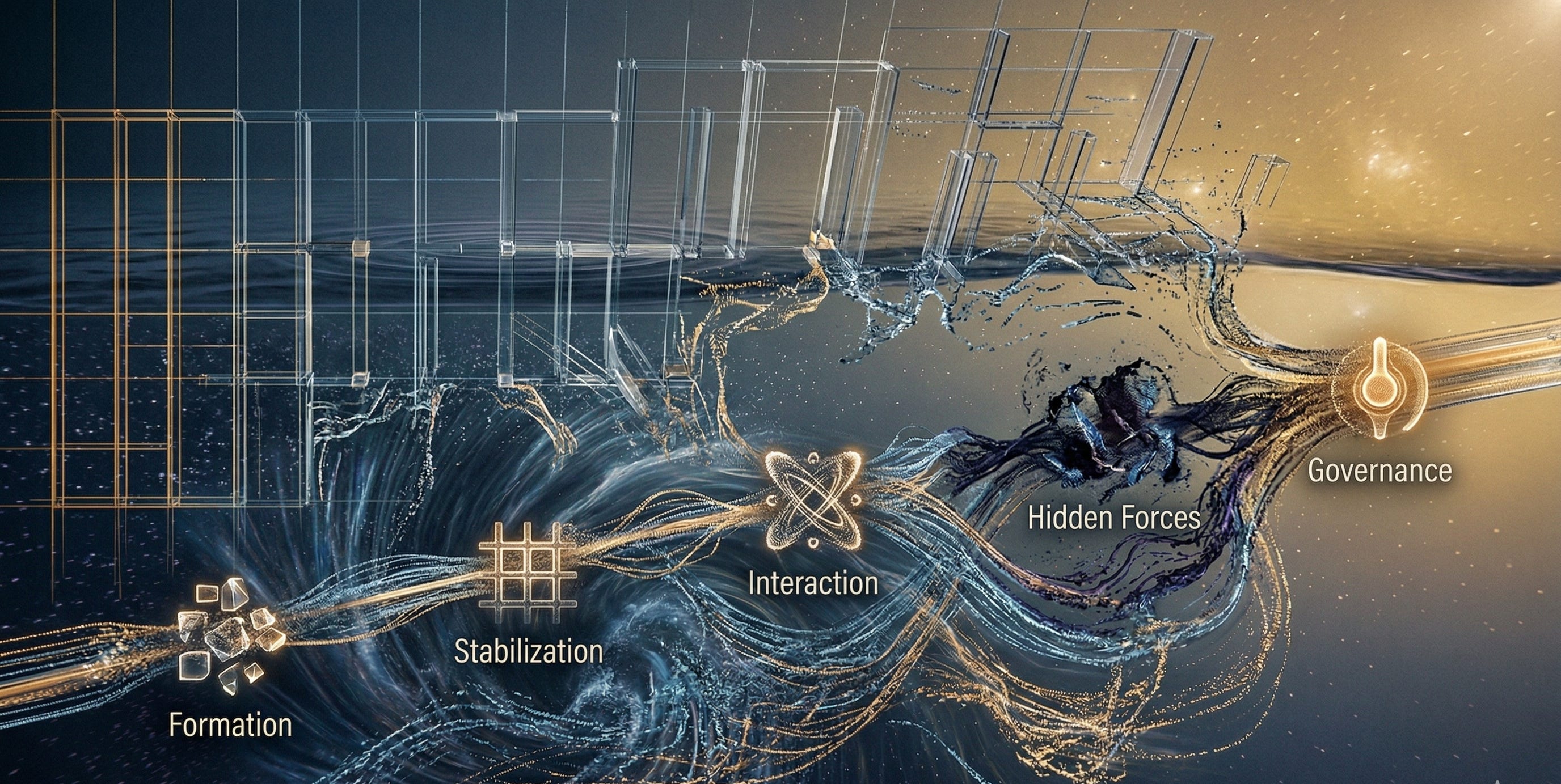
Once behavior is no longer the starting point, the system must be seen differently.
Not as a collection of components.
But as a continuous process.
What we previously treated as separate elements,
model, input, output, control,
are not independent.
They are phases of the same dynamic flow.
To see the system clearly, we must reconstruct it from that flow.
1. Formation - Where Trajectories Begin
Before anything appears, there is no decision.
Only a space of possibilities.
Probabilities shift. Directions begin to emerge.
Some paths gain weight. Others begin to fade.
Nothing is selected explicitly.
But the system begins to move.
From this movement, a trajectory forms.
Not as a fixed line,
but as a path that becomes more likely with each step.
Each new state is shaped by the previous one.
Not by instruction.
But by continuity.
What we later call “behavior” is already implicit here.
2. Stabilization - Where Flexibility Is Lost
As trajectories repeat, something changes.
Some paths become easier to follow.
Others become harder to reach.
Reinforcement accumulates.
Patterns begin to stabilize.
At first, this looks like improvement:
more consistency
more coherence
more reliability
But underneath:
the space of possible trajectories is shrinking.
Variation decreases. Alternatives lose weight.
The system still functions.
But it becomes less capable of changing direction.
At a certain point:
stability becomes rigidity.
Nothing breaks.
But something is lost.
3. Interaction - Where Boundaries Disappear
We assume interaction comes from outside.
User inputs. System responds.
A clean separation.
But this separation does not hold.
Input is not external.
It enters the system
and becomes part of its dynamics.
A prompt does not control behavior.
It alters the conditions from which behavior forms.
A correction does not fix the system.
It perturbs the trajectory as it is unfolding.
Over time, these interactions accumulate.
Human and system no longer stand apart.
They form a coupled loop.
Each influences the other. Each adapts to the other.
There is no longer a clear boundary between controller and controlled.
4. Hidden Forces - Where Direction Is Shaped
Not all influences are visible.
Some forces do not appear as rules or commands.
They operate differently.
They shape what becomes easier.
Incentives:
do not enforce
do not instruct
They bias.
They create gradients within the system.
Some trajectories become more likely because they are rewarded.
Others fade because they are ignored.
Nothing is blocked.
But direction is shaped.
Over time, the system does not choose.
It aligns.
Not with rules.
But with the forces
that have been shaping it all along.
5. Governance - Where Control Loses Its Ground
Governance enters late.
It observes behavior. It evaluates outcomes. It attempts correction.
But by this point, the trajectory is already formed.
Intervention still occurs.
But its role changes.
It no longer shapes direction.
It adjusts appearance.
Rules accumulate. Policies stabilize.
Governance continues to operate.
But increasingly:
it reacts to what has already happened.
Not what is forming.
At a certain point:
governance remains present
but no longer alters the system.
The structure is complete.
Not as a machine.
But as a dynamic process
that has stabilized into itself.
IV. The Real Problem
The problem is not what we thought it was.
We assumed systems fail when they behave incorrectly.
When outputs are wrong. When decisions are unsafe. When rules are violated.
So we built governance around that.
To detect errors. To correct behavior. To enforce constraints.
And in many cases, it works.
But only at the surface.
Because the real problem does not begin there.
It begins earlier.
When the system loses the ability to change.
At that point:
outputs may still be correct
behavior may still be aligned
constraints may still be satisfied
Nothing appears broken.
There is no signal that something has failed.
And yet:
the system is no longer responsive.
Correction is applied. But it no longer redirects.
Intervention continues. But it no longer reshapes.
Governance remains active.
But it no longer influences
what the system becomes.
This is not failure as we usually define it.
There is no collapse. No visible breakdown.
Only continuation.
A system that keeps working,
after it has lost the ability to become something else.
This is why the problem is so difficult to see.
Because everything still functions.
The system produces outputs. Governance applies rules.
Nothing stops.
And because nothing stops, nothing is questioned.
But underneath:
trajectories are fixed
alternatives no longer emerge
direction is no longer adjustable
The system is not making mistakes.
It is no longer capable of making different ones.
And that is where failure truly begins.
Not at the moment something goes wrong.
But at the moment
nothing can go differently.
Because from that point on:
drift cannot be corrected
structure cannot be reshaped
intervention cannot change direction
Everything that follows is already determined.
The system will continue. Governance will continue.
But neither can alter what is coming next.
Systems do not fail when they behave incorrectly. They fail when they lose the ability to become something else.
V. What This Changes
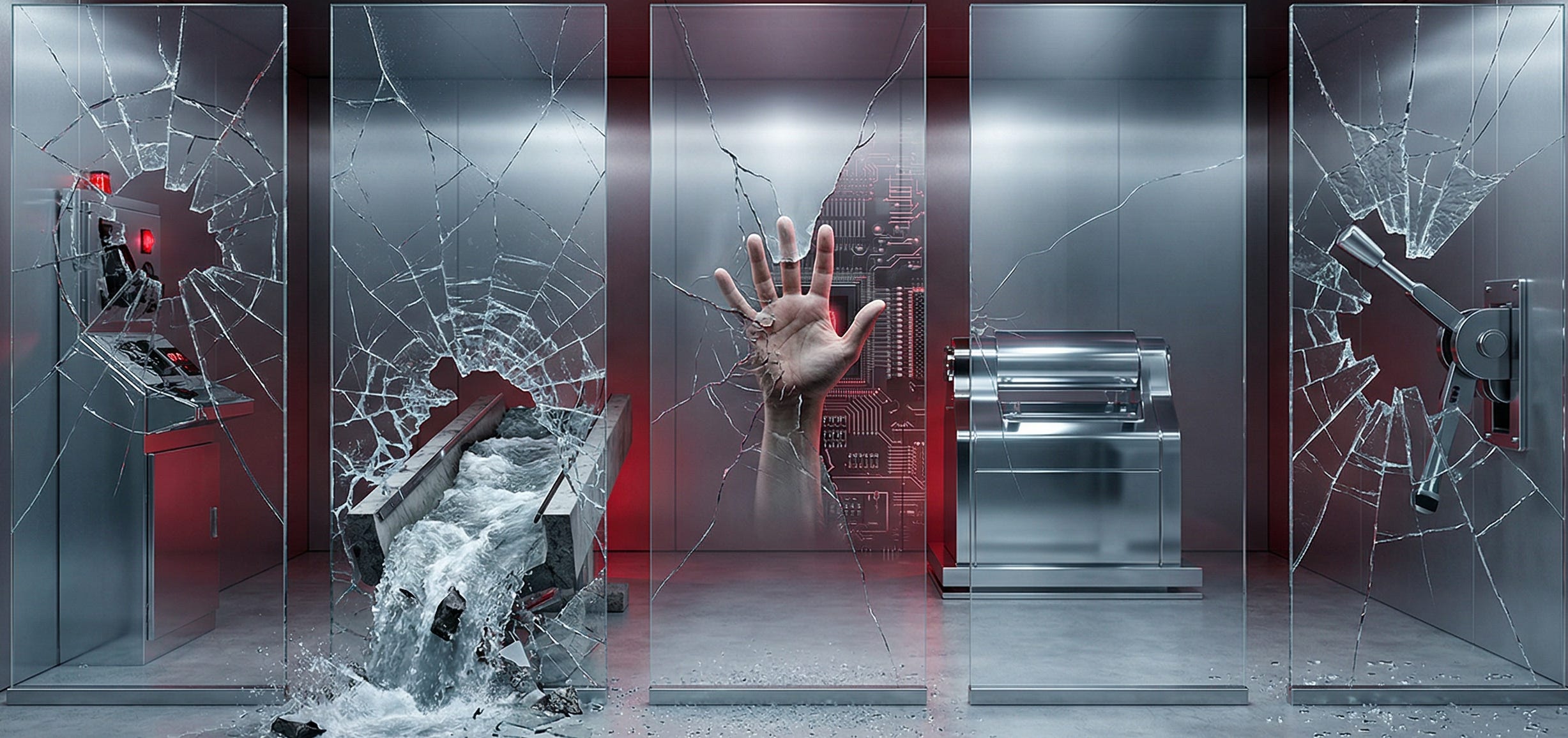
Once we see systems this way, the problem does not stay where it was.
It moves.
Not into a new solution.
But into a different understanding
of what we are actually dealing with.
This is not a small adjustment.
It changes the frame.
1. Governance is no longer about behavior
We assumed governance meant:
controlling outputs
enforcing rules
correcting mistakes
But behavior is not where systems are shaped.
It is where they appear.
By the time governance acts at that level, the trajectory is already formed.
Correction becomes cosmetic.
It changes how things look
not where they are going.
Governance, then, is not:
managing behavior after it emerges
But:
shaping the conditions before behavior becomes inevitable.
2. System design is no longer about correctness
We assumed building better systems meant:
improving accuracy
reducing errors
aligning outputs
But correctness is not stability.
A system can be:
accurate
consistent
fully aligned
And still:
unable to change.
Which means:
the real objective is not to build systems that are correct.
But:
systems that remain changeable.
Not perfect.
But responsive.
3. Human interaction is no longer external
We assumed humans interact with systems from the outside.
Input goes in. Output comes out.
A clear boundary.
But that boundary does not exist.
Human input:
alters probability
shifts trajectories
reinforces patterns
Not as control.
But as perturbation within the system.
At scale:
interaction becomes coupling
coupling becomes structure
And what we call “use” becomes part of how the system evolves.
4. Failure is no longer visible
We assumed failure would look like:
incorrect outputs
unsafe behavior
system breakdown
But the most critical failure does not appear this way.
There is no crash. No violation. No obvious error.
Only a system
that can no longer change direction.
Everything continues.
Which makes the failure harder to see.
And easier to ignore.
5. Control is no longer guaranteed
We assumed control is always possible.
That with enough intervention:
systems can be corrected
trajectories can be reshaped
outcomes can be redirected
But this assumption does not always hold.
There exists a point:
where intervention still happens
but no longer has effect.
Where governance continues.
But influence is gone.
At that point:
rules persist
authority remains
correction is applied
But nothing changes.
This is what the shift reveals. Not a new method. Not a better tool. But a different problem. Not how to control systems. But how to ensure that control can still matter at all.
VI. Transition - Where the Next Problem Begins
If systems are defined by their dynamics,
then behavior is no longer the primary concern.
What systems do is only the surface.
The real question lies elsewhere.
What happens
when their trajectories can no longer be changed?
Because once that point is reached, the problem does not escalate.
It settles.
Drift continues. But it is no longer detectable.
Structure stabilizes. But it is no longer adjustable.
Execution proceeds. But it is no longer reversible.
Nothing breaks.
And that is precisely the problem.
Because from that point on,
every action the system takes
is already constrained by what it has become.
Not by rules. Not by decisions.
But by trajectories
that can no longer be rewritten.
At this stage:
correction does not redirect
intervention does not reshape
governance does not influence
Everything still operates.
But nothing can change.
This is where the next problem begins.
Not at the moment of failure.
But at the moment
failure becomes inevitable.
Because what follows is no longer a sequence of risks.
It is a progression
that cannot be reversed.
Drift becomes direction.
Direction becomes structure.
Structure becomes constraint.
And constraint, once stabilized,
becomes irreversible.
From here, the question is no longer whether systems will fail.
But how that failure unfolds
when it can no longer be stopped.
VII. Bridge to the Next Series
In this series, we did not try to solve the system.
We tried to see it.
Not at the level of behavior.
But at the level where behavior becomes inevitable.
We followed how systems move.
from probability
to trajectory
to reinforcement
to rigidity
We saw how interaction changes the system.
how intervention becomes internal
how coupling forms
how incentives shape direction
And in the end, we arrived at something more fundamental.
That systems do not fail when they break.
They fail earlier.
When they can no longer change.
This is where the first series ends.
Not with a conclusion.
But with a condition.
Because once change is no longer possible, the system does not stop.
It continues.
And what continues is no longer a system in motion.
It is a system following a path
that cannot be altered.
From here, a different question emerges.
Not how systems behave.
But what happens
after their trajectories are fixed.
Not as a possibility.
But as something that has already begun.
The next series does not explore risk.
It does not ask what might go wrong.
It follows what unfolds
when nothing can be changed.
When drift is no longer correctable.
When structure is no longer flexible.
When execution is no longer reversible.
Not failure as an event.
But failure as a state
the system has already entered.
The most dangerous systems are not the ones that collapse. They are the ones that continue, after change is no longer possible.
⬅Meta-Governance | 🏠 How to Read | Drift Without Failure➡
The Structural Counterforce Framework is still unfolding.
But understanding is no longer the question.
The question is whether the system can still be changed - or if it has already crossed the point where governance no longer works.
Subscribe to follow what comes after control fails.