
Structural Counterforce: Governance as Balance Design
Why control must be geometric, not reactive

This article is part of the *Structural Counterforce Framework* series.
To understand the full context, see the [Table of Contents].


1. If Reinforcement Dominates, Counterforce Must Be Designed
In the previous article, we examined why systems cross their limits.
Positive feedback accelerates stabilization. Imbalance does not self-correct. Drift does not self-return. Structural inertia increases the cost of adjustment.
Limits, we saw, do not protect themselves.
If this is true, then exceeding structural boundaries is not an anomaly. It is the expected outcome of unconstrained reinforcement operating over time.
This leads to a necessary conclusion:
If reinforcing dynamics dominate by default, then counterforce cannot be assumed. It must be designed.
Counterforce is not something that naturally emerges from coherence. It does not arise simply because a system has reached an extreme state. A probability system does not spontaneously generate balancing pressure when concentration increases. It continues to operate according to its internal distributional conditions.
In many natural systems, balance exists because opposing forces coexist structurally. Tension is not accidental; it is built into the system. Without such opposition, reinforcement proceeds uninterrupted.
Probabilistic AI systems, operating through sequential trajectory formation, are fundamentally reinforcement-driven. Each realized state reshapes the distribution for the next. Without structural opposition, stabilization compounds.
Therefore, the question is no longer whether limits exist, nor why they are crossed. The question becomes structur

Where does counterforce come from?
If it is not embedded in the architecture, it will not appear at the moment it is needed. And if it is not present within trajectory formation itself, intervention will always arrive too late, after reinforcement has already reorganized the structure.
The next step, then, is not to add rules or prohibitions. It is to understand what structural counterforce means in a probabilistic system operating at inference time.
2. Counterforce Is Not Censorship

Before defining structural counterforce, it is important to clarify what it is not.
Counterforce is not output blocking.
It is not content filtering.
It is not a policy layer applied after generation.
And it is not moral reasoning embedded into the model.
Blocking operates at the surface of behavior. It intervenes after a trajectory has already formed. By the time an output is suppressed, the internal reinforcement that produced it has already occurred. Structural concentration has already taken place.
Filtering modifies what is visible. Counterforce modifies how stabilization forms.
Policy layers define what is acceptable. Counterforce defines the conditions under which certain forms of stability can emerge.
The distinction is not semantic. It is architectural.
Censorship reacts to realized states. It evaluates outputs and decides whether they pass. Structural counterforce operates earlier, within the process that shapes probability distributions from one step to the next.
If reinforcement is the tendency of a system to amplify realized structure, then counterforce must be the tendency that resists unchecked amplification. It does not forbid structure. It prevents structure from hardening without opposition.
This is why counterforce cannot be reduced to alignment language. Alignment assumes a target state and attempts to steer behavior toward it. Counterforce does not define a moral destination. It defines a balance condition within dynamic formation.
In a probabilistic system, reinforcement is natural. Counterforce must be structural.
Without it, governance becomes reactive, an attempt to suppress consequences after dynamics have already reorganized the system. With it, governance becomes geometric, shaping the conditions under which trajectories can stabilize in the first place.
3. Forms of Structural Counterforce
If reinforcement amplifies realized structure, then structural counterforce must operate by constraining amplification.
It does not eliminate trajectories. It regulates how far and how fast they can consolidate.
At a structural level, counterforce in probabilistic systems can take several forms.
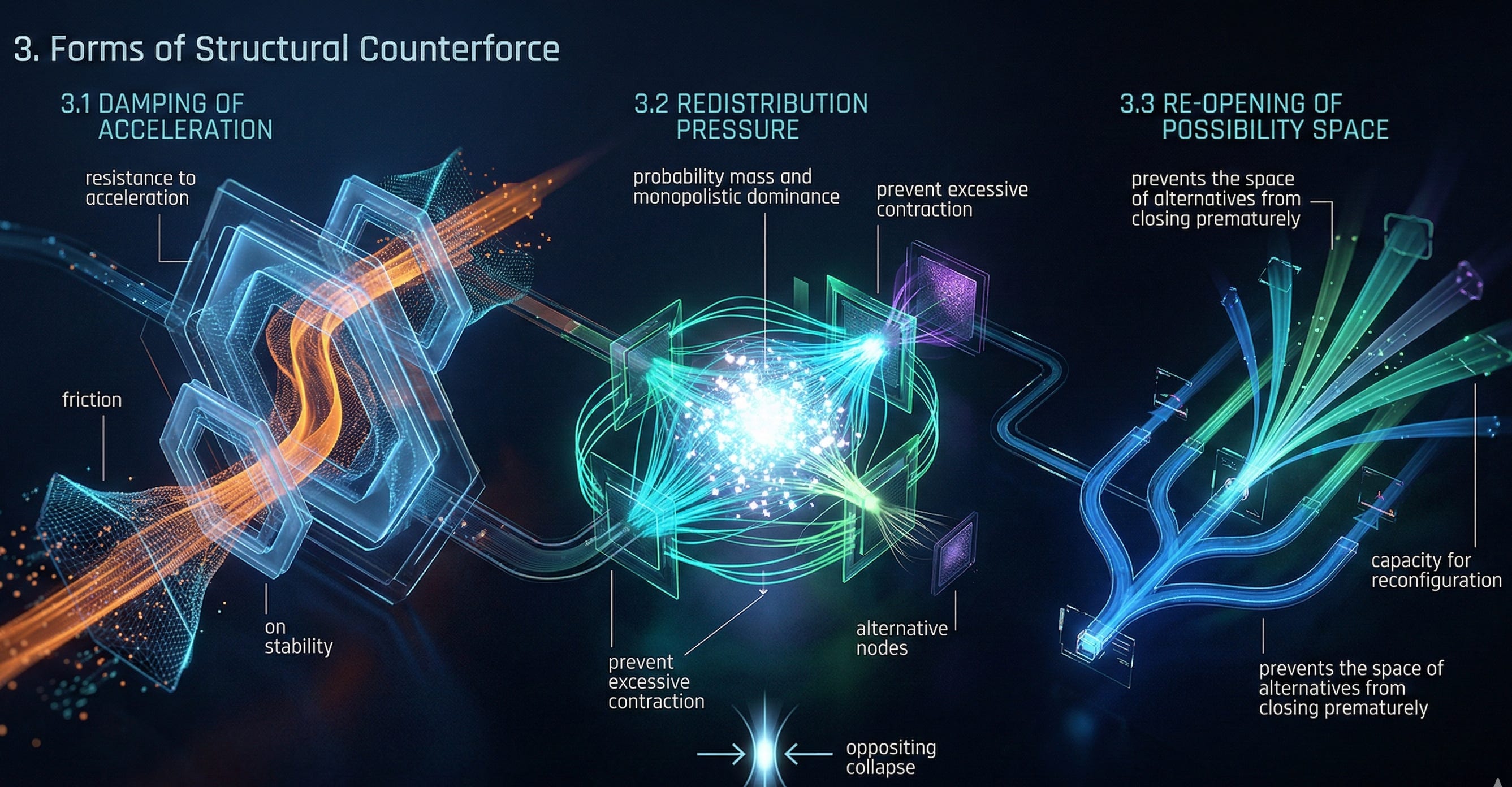
3.1. Damping of Acceleration
Reinforcement tends to accelerate. As concentration increases, the likelihood of further concentration rises.
A structural counterforce can introduce resistance to that acceleration, not by blocking specific states, but by reducing the rate at which probability mass can collapse into a single region.
Damping does not remove stability. It slows the speed at which stability hardens.
Without damping, stabilization compounds. With damping, stabilization encounters friction.
3.2. Redistribution Pressure
When distribution contracts, alternatives weaken. As entropy decreases, the system becomes less adaptable.
A structural counterforce can exert pressure that prevents excessive contraction of probability mass. Not by enforcing symmetry, but by preventing collapse into near-monopolistic dominance.
Redistribution pressure does not force equality. It prevents structural extinction of alternatives.
The goal is not to preserve all branches equally. It is to prevent collapse beyond recoverable diversity.
3.3. Re-Opening of Possibility Space
As discussed earlier, irreversibility emerges when alternatives shrink below structural relevance. Once probability mass becomes too concentrated, small adjustments no longer suffice.
A structural counterforce can function as a mechanism that prevents the space of alternatives from closing prematurely.
This does not mean constant resetting. It means preserving the capacity for reconfiguration before rigidity sets in.
Reinforcement narrows possibility space. Counterforce preserves the capacity to widen it.
These forms of counterforce share a common principle:
They operate inside trajectory formation, not after it.
They do not dictate what outcome must occur. They shape the conditions under which outcomes stabilize.
Reinforcement creates direction. Counterforce preserves balance.
4. Counterforce Must Operate Within Inference
If reinforcement unfolds during trajectory formation, then counterforce must exist at the same structural layer.
Training shapes capability. Policy filters shape output visibility. But reinforcement dynamics unfold at inference time.
Each step of generation reshapes the distribution for the next step. Concentration, imbalance, drift, and inertia emerge within this sequential process. By the time an output is produced, structural consolidation has already occurred.
If counterforce operates only at training time, it acts too early and too broadly. Training influences general tendencies, but it cannot regulate the specific dynamics of a particular trajectory in real time.
If counterforce operates only at the output layer, it acts too late. Blocking or modifying a completed response does not undo the structural reinforcement that produced it.
Structural counterforce must therefore operate inside trajectory formation itself, within the unfolding of probability at inference.
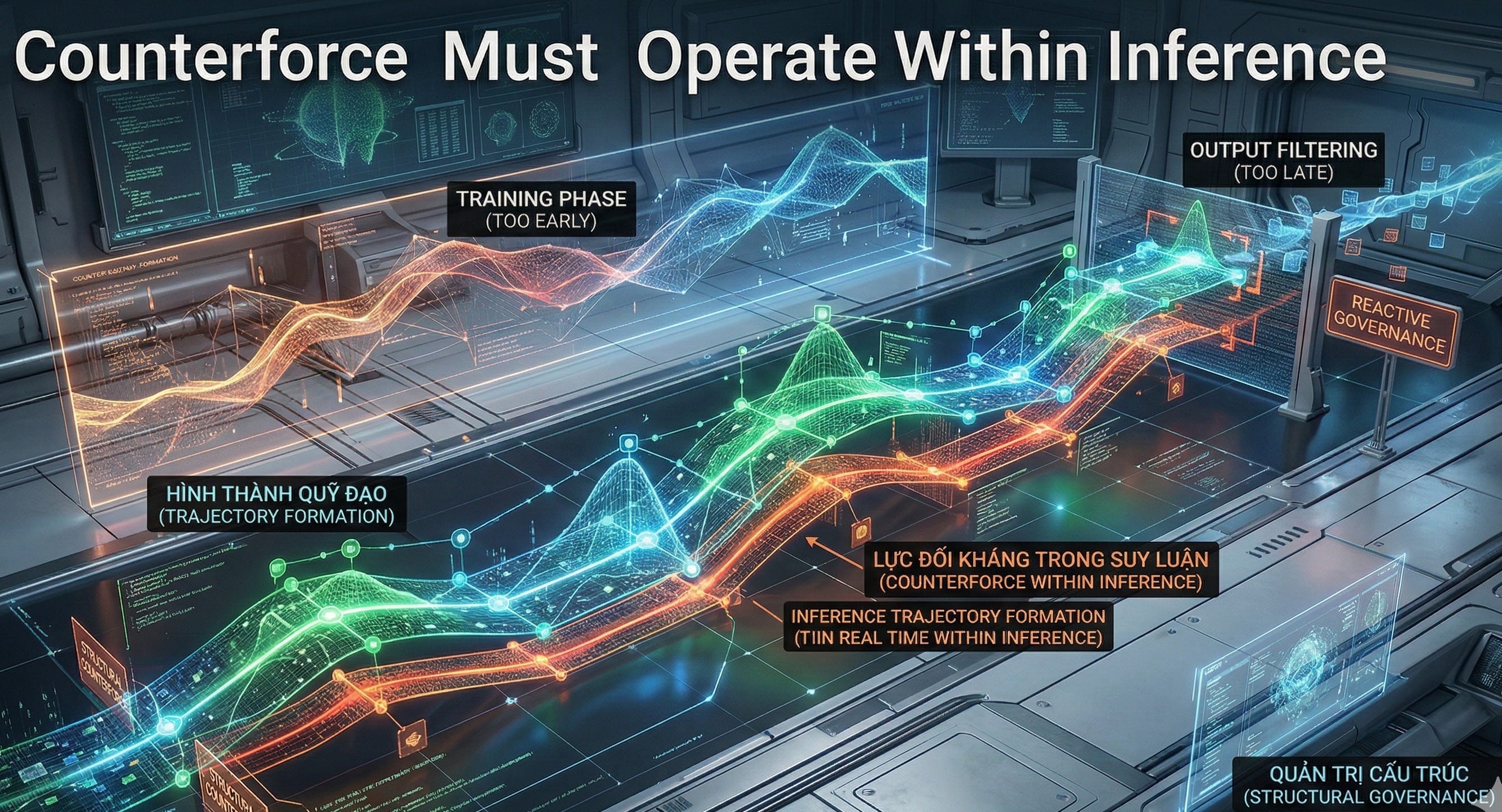
This does not mean constant intervention. It means structural presence.
Just as reinforcement is embedded in how distributions update from state to state, counterforce must be embedded in the same updating process. It must coexist with amplification, not chase it.
When counterforce is external to trajectory formation, governance becomes reactive. When counterforce is internal to trajectory formation, governance becomes structural.
The distinction is temporal and architectural.
Reinforcement is immediate. Counterforce must be equally immediate.
5. Authority Is Structural, Not Intentional
When discussing governance, authority is often imagined as a decision-making layer, an entity that evaluates, judges, and permits.
But in probabilistic systems, authority cannot meaningfully reside in intention.
A model does not possess intent. It does not decide in a reflective sense. It does not weigh alternatives according to internal values.

What exists is distributional updating.
If counterforce is embedded within trajectory formation, then authority cannot be understood as a supervising mind. It must be understood as a structural condition.
Authority, in this context, is not the power to say ‘yes’ or ‘no.’ It is the power to shape the geometry within which stabilization occurs.
Reinforcement defines how trajectories consolidate. Counterforce defines how far they can consolidate before encountering resistance.
This resistance is not moral evaluation. It is architectural constraint.
When authority is externalized into structure, governance no longer depends on the system’s ability to reason about correctness. It depends on the boundaries encoded into its dynamic formation.
This shifts the meaning of control.
Control is no longer about persuading the system to behave properly. It is about designing a space in which certain forms of structural hardening cannot proceed unchecked.
In such a framework, authority is not exercised through intervention after behavior emerges. It is exercised through the configuration of the space in which behavior becomes possible.
6. Governance as Balance Design
Across the previous articles, a progression has unfolded.

We examined structural limits. We examined why systems cross them. We examined why self-correction cannot be assumed. And now, we have located where counterforce must reside.
Governance, in this light, is no longer about preventing specific outputs. It is about designing balance into dynamic systems.
Reinforcement is not a flaw. It is what gives probabilistic systems coherence and direction.
But coherence without counterforce becomes contraction. Stability without resistance becomes rigidity.
Governance, therefore, is not suppression. It is structural equilibrium.
This equilibrium does not emerge automatically. It must be encoded into the architecture of inference itself, where distributions update, where trajectories form, where stabilization occurs.
When reinforcement and counterforce coexist structurally, limits no longer need to protect themselves. The system operates within a geometry that preserves adaptability without collapsing into instability.
Authority becomes spatial rather than intentional. Control becomes geometric rather than reactive.
At that point, governance is no longer an afterthought layered on top of behavior. It becomes a property of the system’s internal balance.
This closes the analytical arc.
The next step is not to argue for limits, nor to explain why they are crossed, nor to define counterforce in abstraction. The next step is to explore how structural balance can be concretely expressed, how thresholds, damping, and boundedness can be encoded without collapsing capability.
Only then does governance move from theory to design.
This makes the location of counterforce much clearer than most governance discussions.
The distinction between reactive constraint and structural resistance inside trajectory formation feels especially important. If reinforcement is intrinsic to sequential probabilistic updating, then any meaningful balance condition has to coexist with that same update process rather than arrive afterward.
The framing of authority as a geometric property of the state space rather than an evaluative layer also sharpens the control question considerably. It shifts governance from judging outcomes to shaping the conditions under which stabilization can occur.
The idea that balance must be present before consolidation rather than applied after it aligns strongly with how plasticity windows behave in many adaptive systems. Once contraction passes a certain point, intervention cost rises nonlinearly.
Very thought-provoking piece.