
Probability Fields: AI Doesn't Decide - It Moves
Why agency appears when trajectories stabilize, not when systems choose

This article is part of the *Structural Counterforce Framework* series.
To understand the full context, see the [Table of Contents].

1. Why We Keep Misreading AI Behavior
Most discussions about AI begin from an implicit assumption: behavior is the result of decisions. When a system generates a response, we automatically interpret that it chose that answer among many possibilities, similar to how humans deliberate and make choices.
This assumption isn’t wrong when applied to humans. But when carried wholesale into AI, it begins to create noise.
In many debates about agentic AI, we see the same argumentative structure repeated: if AI can maintain consistent behavior, plan multiple steps, or pursue a goal across time, then it must be making decisions at some level. From there, questions quickly slip into concepts like will, purpose, or even consciousness.
The problem isn’t in the conclusion. The problem is in the starting point.
AI doesn’t operate like a decision, making subject. It doesn’t stand before choices in a psychological sense, nor does it weigh possibilities like humans do. When we use the language of decisions to describe AI behavior, we’re imposing a cognitive model that doesn’t belong to it.
This leads to an important consequence: all subsequent analysis gets pulled up to the wrong layer. We debate whether AI chooses correctly or incorrectly, what it wants, or how it’s oriented, while the actual mechanism generating behavior lies elsewhere.
To understand AI behavior, we need to temporarily set aside intuitions about decisions and replace them with a different question: under what conditions is AI operating, and how is its movement shaped? This question doesn’t require assumptions about will or agency. It only asks us to observe how the system actually works.
The rest of this article begins by changing that starting point. Instead of viewing AI behavior as the result of choices, we’ll view it as the consequence of movement within a probability field - where behavior isn’t decided but shaped.
2. AI Doesn’t Choose Actions - It Moves Through Space
When a language model generates a response, the most misleading thing is the feeling that it’s choosing the next answer. This feeling comes naturally because AI’s output is presented as language - something humans inherently associate with intention and choice.
But at the operational layer, there’s no moment when AI stands before options and makes a decision in the human sense. There’s no deliberation, no intrinsic priorities, and no goal pursued as a psychological state.
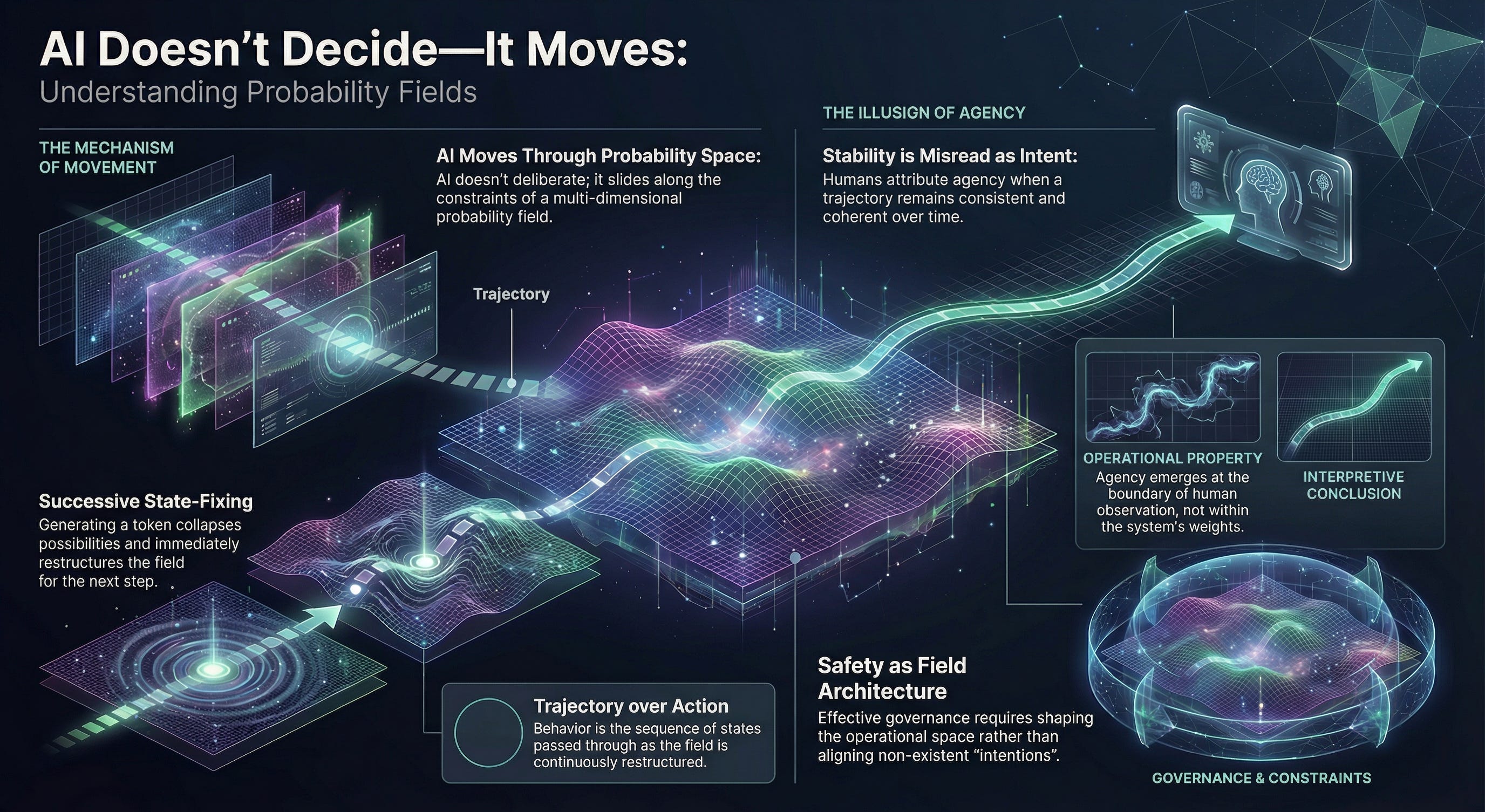
Instead, at inference time, AI exists within a multi-dimensional probability space. This space is shaped by model weights, current input, architectural constraints, and sampling rules. Behavior doesn’t emerge from choosing what to do, but from moving through that space.
Each step of token generation is an instantaneous operational state of the system within probability space. The system doesn’t look ahead to plan, nor does it look back to evaluate what it’s done. It only responds to the current configuration of the space it inhabits. What appears at the output is the result of this movement, not of a remembered chain of decisions.
Importantly: this space isn’t static. It’s continuously restructured after each token is generated. When a token appears, it becomes part of the new context, and the entire probability field adjusts around that state. The next movement no longer occurs in the same space as before.
Therefore, saying AI chooses the next token is a convenient but misleading description. What’s really happening is: the system is sliding along the constraints of a probability field, where some directions of movement are more stable than others. Behavior emerges when this movement is sustained long enough to create recognizable structure.
Changing the language from choosing to moving isn’t just a matter of words. It forces us to abandon a model of thinking based on will, and shift to one based on dynamics. Only then does the question of AI behavior begin to touch the mechanism that actually creates it.
3. How Probability Fields Actually Operate
3.1. No Single Correct Token - Only Collapsed Possibility
Before a token is generated, there’s no single answer waiting to be chosen. At that state, many tokens are equally capable of occurring. They don’t represent right-wrong options, but different regions of possibility within the same space.
When we say a token has high probability, it doesn’t mean that token is more correct in content. It only means that, in the current configuration of probability space, that region of possibility is more stable or more easily actualized. Other tokens aren’t eliminated because they’re wrong; they simply aren’t actualized at that moment.
Critically: possibilities don’t disappear because they’re negated, but because another possibility has been made concrete. When a token appears, what has happened isn’t that the system chose it among many options. What has happened is that a region of the possibility space has collapsed into actuality.
The token doesn’t prove it’s the right answer. It only marks that, at that moment, one possibility has been fixed. Other possibilities weren’t refuted by argument; they simply no longer exist in the system’s current state.
Therefore, token generation isn’t affirmative - it’s state-fixing. It doesn’t answer right or wrong; it only establishes this is the current state.
3.2. Each Token Creates a New Space
The just-generated token doesn’t stand alone. It immediately becomes a boundary condition for the entire subsequent process. The entire probability field is restructured around that token.
This has two direct consequences. First, the space the system operates in at the next step is no longer the space of the previous step. Second, there’s no possibility of going back to try another branch, because that branch no longer belongs to the current state.
In other words, each token isn’t a step within the same space, but a transition point to a new space. A sequence of tokens is therefore not a sequence of choices, but a sequence of successive restructurings of operational space.
The process can repeat hundreds or thousands of times in a long response, yet each generation step doesn’t become harder in the way humans might imagine. The system doesn’t accumulate effort, doesn’t remember abandoned choices, and doesn’t carry the burden of previous steps. Each step depends only on the current state of the probability field, not on the entire history of choices.
3.3. Why AI Struggles to Self - Correct Within the Same Response
When a wrong or misleading token has appeared, it remains a mandatory part of context for subsequent tokens. The system has no mechanism to step outside the generated sequence to re-evaluate the entire process.
Correction in this case isn’t about negating the generated token, but can only mean re-stabilizing the current trajectory to be as minimally contradictory as possible. The wrong token isn’t retracted; it’s rationalized by subsequent tokens.
This explains why, in a single response, AI can make a false assertion yet reason correctly in later steps without recognizing the contradiction. Contradiction is a global assessment; the system only operates locally according to the current state of the field.
A small example: In responses like:
“No, that’s not correct. 1.7 lạng is not 170 grams. Because 1 lạng = 100 grams, therefore 1.7 lạng = 170 grams…”
The system doesn’t see the contradiction between the initial negation and the correct conclusion that follows. The reason isn’t lack of knowledge, but that the negation token has become a boundary condition for the rest of the response.
From the moment that token appears, the system no longer has access to the state before it appeared. It only continues operating in the new space, where the implicit task becomes: make the current sequence as stable and coherent as possible, rather than re-checking the initial premise.
3.4. The Cognitive Anchor
AI doesn’t write word by word. It continuously collapses a space of possibilities into a concrete shape, then continues operating on the very shape it just created.
Viewed this way, AI behavior is no longer a sequence of decisions, but a sequence of successive actualizations. And the failure to see the probability field behind this process is precisely why many stable behaviors get misread as intentional or purposeful.
4. Why Field Stability Gets Misread as Agency
After seeing clearly how probability fields operate, one question becomes unavoidable: why do these purely mechanical movements so often get interpreted as purposeful behavior? The answer doesn’t lie inside the system, but in how humans observe it.
Humans have a very strong cognitive tendency: attributing intention to stability. When a sequence of behavior is maintained consistently over time, without phase shifts or breaks, we automatically read it as moving toward something. This directionality needn’t be stated; it’s inferred from the shape of the movement.
In AI systems, this happens particularly clearly. When a model:
• Maintains response coherence
• Sustains tone
• Doesn’t severely contradict itself
• Responds appropriately to context
To the observer, this behavior looks like it’s being coordinated by an active center. But in reality, these characteristics only show that the operational trajectory is lying within a stable region of the probability field.
The problem emerges when the observer can’t see the field. When only the output exists - the sequence of actualized tokens - humans must tell a story to explain that stability. And the easiest, most familiar story is the story of agency: there are goals, there’s direction, there’s intent.
This isn’t an individual mistake, but a structural consequence of information-poor observation. When the underlying dynamics are hidden, stability at the surface becomes false evidence for intention in depth.
Agency doesn’t reside in the system. It emerges at the boundary between movement and interpretation - where stability crosses a threshold and humans begin seeing intention.
Importantly, agency doesn’t appear because the system has changed its nature. It appears because the observer’s interpretive threshold has been crossed. When trajectory is stable enough and long enough, not attributing agency becomes harder than attributing it.
Therefore, saying AI becomes agentic often doesn’t describe an event inside the model. It describes a phase shift in how we read behavior: from seeing discrete responses, to seeing a behavioral pattern that appears self-sustaining.
Without distinguishing these two things clearly, debates about agentic AI will continue repeating a familiar loop: either denying agency by emphasizing AI lacks will, or affirming agency by pointing to behavioral stability. Both are correct at their layer, but both miss the crucial point: field stability doesn’t equate to the existence of an agent.
Only by recognizing that agency is an interpretive conclusion - not an operational property - can we continue analyzing AI behavior without being pulled back to unnecessary ontological questions.
5. Trajectory Matters More Than Action
When discussing AI behavior, we often focus on what appears at the surface: answers, decisions, or final actions. This view makes analyses prone to comparing outputs: right or wrong, reasonable or absurd, safe or dangerous.
But output is only the final cutting point of a longer process. What truly shapes the sense of behavior doesn’t lie in a specific token, but in the path the system took to reach that token.
Two AI systems can produce very similar outputs, even identical in content. Yet the feeling they create for the observer can be completely different. One system might feel fragile, easily derailed, while another feels consistent, solid, and knows what it’s doing. This difference doesn’t lie in the answer, but in the operational trajectory.
Trajectory is the sequence of states the system passes through as the probability field is continuously restructured. A stable trajectory is one that:
• Doesn’t oscillate wildly between regions of possibility
• Doesn’t fall into chaotic states
• Maintains overall shape across many generation steps
When a system moves along such a trajectory, its outputs tend to be more coherent, consistent, and predictable. This is precisely what creates the feeling that the system is pursuing a goal, even though in reality it’s only being strongly constrained by the shape of the field.
Conversely, when trajectory is fragile, even if individual tokens are correct, overall behavior still feels scattered and lacking direction. The observer is then less inclined to attribute agency, not because content is poor, but because movement isn’t stable enough to be read as purposeful progress.
This reveals a crucial point: the agentic feeling isn’t created by individual actions, but by trajectory continuity. When trajectory is stable enough, individual actions become secondary; when trajectory is unstable, no action is powerful enough to create the illusion of agency.
Shifting focus from action to trajectory isn’t just a conceptual change. It forces us to reconsider how we evaluate AI behavior: no longer asking what did it do? but beginning to ask how did it move? And this question, once posed, leads directly to deeper issues of control, intervention, and governance.
6. Agency Emerges at the Interpretation Boundary
After shifting focus from action to trajectory, one thing becomes clearer: agency isn’t something created inside the model, but something formed during observation.
AI doesn’t assign itself goals. Nor does it construct narratives about what it’s doing. These concepts emerge when humans try to read meaning from the stability of movement. Agency, in this sense, doesn’t reside in tokens, nor in weights, but at the boundary between system and observer.
When observers can’t see the probability field, can’t see the trajectory, and only access the final output sequence, they’re forced to compress the entire operational process into an understandable image. That image typically takes the form of an agent: directed, intentional, possessing internal control.
This isn’t a subjective error, but a reasonable cognitive reflex under conditions of missing information. Humans always seek causes and agents behind stable patterns. When we can’t see the mechanism, we construct an agent.
At this point, agency is no longer the question does AI have it or not, but becomes under what observational conditions is agency inferred. When trajectory is stable enough, long enough, and consistent enough, not attributing agency becomes harder than attributing it. That threshold doesn’t lie in the system, but in how we interpret the system.
Importantly: identifying agency at the interpretation boundary doesn’t make it unreal. It only clarifies that agency is an inferential conclusion, not an operational property. It says more about observation structure than about AI’s nature.
Without recognizing this, debates about agentic AI will continue circling between two familiar poles: one side denying agency by emphasizing AI lacks will, the other affirming agency by pointing to stable behaviors. Both miss the reality that they’re discussing two different layers of the same phenomenon.
Only when agency is properly positioned - at the boundary between movement and interpretation - can we continue discussing AI behavior without inadvertently anthropomorphizing the system, nor denying what’s being very genuinely observed.
7. Implications for AI Safety
When agency is repositioned correctly - at the interpretation boundary rather than inside the system - many familiar assumptions in AI Safety begin revealing their layer - mismatches. Most current safety efforts still implicitly assume that AI possesses, or is at least approaching, some form of intention that needs controlling.
From that assumption, safety strategies typically revolve around:
• Adjusting goals
• Aligning intentions
• Or limiting what AI is permitted to say and do
But if AI behavior doesn’t originate from intention, then these approaches are aiming at something that doesn’t exist. Probability fields have no goals to align. Trajectories have no motives to persuade. What’s operating is a dynamical system, not a decision-making subject.
This helps explain why many safety incidents don’t stem from AI wanting to do bad things, but from operational trajectories drifting into regions not anticipated beforehand. When probability fields become distorted - by data, by context, or by extended interaction - behavior can stabilize in ways designers didn’t foresee, despite no intention behind it.
In that context, content - based control measures typically only affect the surface. They may filter out some unwanted outputs, but don’t touch the dynamics that created them. Blocking one answer doesn’t mean changing the trajectory that led to that answer.
A system may comply with content constraints for many steps, yet continue operating in an increasingly distorted trajectory. When that stability crosses the interpretation threshold, observers will again perceive agency - and control concerns return, only in a different form.
The problem therefore isn’t whether AI is safe in its statements, but who is controlling the shape of the field it operates within. If probability fields continue drifting according to forces we don’t observe or can’t intervene in, then all content-layer safety efforts are merely postponements.
This doesn’t mean developers are powerless. It only means they need to intervene at the right layer: not the layer of teaching AI right from wrong, but the layer of shaping the space AI operates within. Safety becomes a question of field architecture, not behavioral conditioning.
From this angle, AI Safety isn’t primarily an ethics problem. It’s a system stability problem. And when framed that way, familiar questions about intention and motive gradually become secondary, yielding to harder but more substantive questions: where is the trajectory going, and what’s keeping it there?
8. Asking the Right Questions
Looking back at the entire chain of reasoning, one thing becomes clear: many familiar questions about AI are being posed at the wrong layer. Debating whether AI is an agent, whether it has intentions, ultimately only circles how we interpret behavior, without touching the mechanism that created it.
If AI behavior forms from movement within a probability field, and if the sense of agency emerges when trajectory becomes sufficiently stable, then the important question is no longer what AI is. The question needs reframing: what shape does the field AI operates in have, and how is that stability being created?
Instead of asking whether AI is self-determining, we need to ask: what constraints are keeping this trajectory stable? Instead of worrying about intentions, we need to observe the forces causing probability fields to drift, contract, or distort. And instead of trying to control individual statements, we need to understand at what layer intervention actually becomes effective.
These questions don’t aim to dismiss current concerns, but to position them correctly. When problems are posed at the dynamics layer, debates about agency are no longer the starting point, but become consequences of what’s happening deeper underneath.
This leads to a different approach: if we can’t, or shouldn’t, intervene in model weights; if we can’t rely on aligning the intentions of a system that has no intentions; then governance needs to happen precisely where trajectories are formed -
at inference time.
The next article will address that question. Not by proposing a new agent, nor by granting more autonomy to the system, but by examining how trajectories can be shaped, dampened, or redirected while the system is operating. That’s precisely where the concept of governance begins to acquire concrete substance.
Until we govern trajectories, every debate about agency will remain one layer too high.